Saturday, March 10, 2012

Sad saga of our permesso di soggiorno; I explain again how NOT to get an Italian document

Friday, March 9, 2012
Although I am writing this today, what I describe is actually a series of events Lucy and I, along with daughters Suzye and Lindsey, went through from September through November of 2001 in Padova.  I had accepted a position at the English International School of Padua, teaching fifth grade from September through mid-June. I hadn’t found time to put this story in writing until now.

Travel books and websites advise that anyone staying in Italy for more than 90 days must first have a visa and then apply for a permesso di soggiorno, permission to stay in Italy, within eight days from arrival. However, the advisers go on to explain that this law is not enforced and that travelers need not go to the trouble, and they rarely do. It is mostly needed for those who wish to legally work or attend school in Italy. Although I am teaching here, the school did not have time to get me a proper work permit, so I am officially a tourist who is being paid in cash sotto il tavolo.

We see no need for a permesso di soggiorno, since our housing has already been arranged for us by the school. As long as we don’t break any laws, we will never be asked to show any documents other than our passports. However, we change our minds when I hear that the Commune of Padova offers free Italian classes. Some of the British teachers at my school are already enrolled, and this could save us un sacco di soldi, as the lessons Lucy has signed us up for at Inlingua are going to cost us close to $2,000 a month if we all four take them. I take a 20-minute walk to the government office to sign us up, but I am asked for our permesso di soggiorno, a requirement for the classes.

The permesso di soggiorno must be obtained at the questura, which is the provincial administrative headquarters of the state police. One might think that because foreigners have to register at the questura, the agency would hire some officers who also speak English, Arab and some of the other common languages of the Mediterranean region, but that is not the case. The officers we meet are mostly middle-aged men who speak Italian exclusively. Maybe they figure that in the eight days we foreigners are here legally, we should have learned to speak Italian.

Immigrants in line at the questura. Photo courtesy of
Il CapoLuogo d'Abruzzo, Jan. 2, 2012.
Since I am working during the day, Lucy goes to the questura alone the next morning. She encounters large clusters of Africans and Eastern Europeans milling about in the alley alongside the questura entrance. We have only been in Italy for a couple of weeks, and her knowledge of Italian is minimal, but she finds a helpful student from Croatia who explains that she must sign up on a list posted on a plain sheet of paper taped to the fence beside the entrance gate. She signs, but of course she is low on the list, since everybody waiting has already signed up. Some must have come long before the office opened to get their names high on the list. Almost four hours later, she finally makes it inside the gate, but it is almost closing time; the office is only open three mornings a week. She is given a form and told to fill it out and bring it back in two days, along with four head shots of everyone in our family living here.

As she tells me of her efforts, we are frustrated with the waste of time just to get a form, and I wish I could have been there to help. I wonder when the sign-up list is posted, so the next evening I stay up until midnight and ride my bike to the questura. Sure enough, there is a list posted, and it already has two names on it. I put Lucy down as number three and ride home in the dark and chill, happy that I have been able to contribute to our efforts. We have all had our photos taken, so perhaps things will go more smoothly tomorrow.

Lucy arrives a few minutes before 8 a.m. the following morning, only to behold that the old list is gone and a new one has been posted. Since the list is posted in plain paper, someone in the early morning tore down the list and made his own. Either that, or the list on which I signed was not the official list, and the questura officers replaced it when they came to work in the morning. Lucy can sign up at the bottom of the new list, but she doesn’t have another four hours to waste, so she goes home.

Next week, she tries again, going well before opening hours to put her name on the list and wait around. She makes it inside after a two-hour wait, and an official looks over our forms. He shuffles them around for a minute and tells her she needs something called a marca di bollo. “A what?” she asks. “Che cosa?” He explains again, more slowly, that she must go to a tabaccaio and get a marca di bollo. Lucy walks away, confused, and finds someone in the crowd who speaks English. A helpful straniero explains that a marca di bollo is a government tax stamp that must be affixed; it is the way the document tax fee is paid, and she has to go to a tobacco shop to buy it. So Lucy leaves the questura and pays what amounts to around $10 for each of us, but now she will have to go back to the questura another day.

The next time, thinking that we have everything we need, Lucy and I return together along with Suzye and Lindsey. Could the fourth time be charmed? No, not a chance. Our forms and marca da bollo are fine, but we also need proof of assicurazione, health insurance. This is a difficult word to pronounce, but I think it won’t be difficult to provide, as my school has taken out a traveler’s insurance policy for our family that will provide health care coverage during the school year. I have the assicurazione documents at home, and Lucy can bring them back the next time the questura is open. Va bene, the man says, now that our family has come, we just need one person to bring back the insurance and he can process our documents.

So two days later, Lucy goes for the fifth time. Unfortunately, we didn’t understand that the  assicurazione, of course, must be translated into Italian, and she sadly gives me this news at dinner.

I find that we are not alone in our frustration. At school I meet Matthew Crestani, the father of Ryan, one of my 5th grade students. Matthew is from Texas and has been transferred by his company to oversee its Italian operations in Padova. His family came in the summer and he still has not been able to obtain his permesso, even though his company has hired an Italian who supposedly has expertise in such matters. We swap tales of our frustration and shake our heads.

I am not ready to give up, but I am not willing to spend money hiring a translator or other paid expert, so I use my limited Italian skills and a computer translation program to do my own translation. I have been meeting with an Italian teacher at my school for private lessons, and the entire next lesson is spent with her correcting my insurance papers translation.

Several weeks later, translation in hand, Lucy and I return. What other obstacle can they throw in our path now? We are confident we will get our permesso, though it is now late November, and by this time Lucy and the girls are taking lessons at the Bertram Russell language institute. But we have been working on this for nearly three months, and we are determined to see it through, even if we don't really need it any more.

I see the same man I saw the last time I came, and he looks over the translation very carefully. I am confident because I know it was expertly translated by a native italiana, a teacher no less. But no, there is something here, he says, that doesn’t seem right to him. Here is a line that says not every illness is covered, referring to some pre-existing conditions. I had wondered if that might be a problem when I translated it. Of course I could just have left that line out of the translation, but I wanted to do this the right way, so I kept it. I didn’t really expect anyone to actually read the whole thing, but as luck would have it, I have run into someone who reads the fine print.

I try to explain that the assicurazione will cover anything that happens to us in Italy, and that we have no current medical problems, but he points to the line again and refuses to continue. Is there anything I can do to get my permesso, I ask? I can take my insurance to the questura in Milano, where there is someone who reads English, and he can determine if my insurance is adequate. Otherwise, no, there is nothing more that can be done here.

I leave frustrated and a bit stunned. We have made six trips to the Questura, seven if you count my futile midnight list-signing. The only thing I gain is insight into Italian bureaucracy. Well, there is one other thing: After many weeks of practice, I can finally pronounce assicurazione like a native. We have already found language classes by this time anyway, so it is time to concede defeat. We will live out our remaining months here as tourists, but officially we are illegal aliens, without papers.

The acronym for “without papers” was once thought to be the origin of the unflattering word wop. A hundred years ago, Italians who went to America also had trouble obtaining their paperwork, but they could be hired as day laborers, paid in cash at the end of the day to avoid the need for contracts. This is also supposedly where the nickname dago comes from, as in going to work for the day. Both of these theories have since been debunked. Current wisdom is that wop derives from the slang word guappo, used mostly in the region of Campania to describe certain people as swaggerers or ruffians. Non-Italians heard Italian immigrants using it and thought it applied to all Italians. Dago, it is now believed, came from a corruption of the name Diego, once a generic derogatory term to describe anyone of Latin descent. Whatever—I still like the romanticism of the old explanations. And it adds to the irony of my situation—an American wop coming to Italy and working for cash like a dago.

Meanwhile, I find that the Crestanis have shed their without papers status and finally obtained their documents, not through the hired expert but in that most Italian of ways. It seems that son Ryan is quite a good soccer player, and he has been practicing with a team of local ragazzi, but with the first game coming up within a week, the coach realizes that Ryan can’t play without his permesso. Not a problem, the coach says, because he has a friend at the questura. Between the coach and the friend, the Crestani family has its paperwork in hand in plenty of time for Ryan’s game. Magari! If only I could play soccer!

Back now to 2012, I no longer need to worry about my permesso, because by now I have stumbled through the even more arduous procedure of obtaining Italian citizenship jure sanguinis, through my ancestors, or more literally, my blood. 
And thats a whole other long story . . .

Thursday, March 8, 2012

Tackling Italian bathrooms mysteries

Friday, March 9
I’ve been here long enough now that I feel confident enough to get down and dirty and take on some questions that have bewildered people about Italy for many years—bathrooms. Thirteen years ago, Lucy and I were traveling in Italy with friends Dick and Bo. It was my second time in Italy and the first trip for the others, and the first night in our hotel, Dick posed a perplexing question: “What’s with those cords that hang from the walls in all the bathrooms?”

“I don’t know,” I said, “but don’t pull on it.”

“I already did,” Dick said. “Nothing happened.”

Wise traveler that I am now, I understand that these cords are required by Italian building codes so that people can summon help if they slip on the bathroom floor. And if you’ve ever taken a shower in an old Italian hotel or hostel, you will recognize the need for the emergency pull cord, since in some cases the shower is simply a showerhead and a drain in the middle of the bathroom floor. If there is a curtain, it usually does not extend high enough or low enough to prevent water from splashing all over the bathroom, making it look like the aftermath of a thunderstorm. Bathroom floors are made of smooth tiles that become slippery when wet, increasing the likelihood that you will need the pull cord when you crack your head on the bidet.

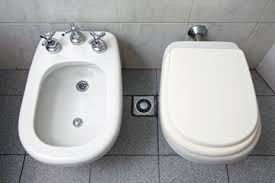
Bidet, left. Toilet, right.
Speaking of the bidet, this is also a curious item required by building codes. Since I have pledged to “get to the bottom” of the bathroom situation for my loyal readers, I must explain that bidets are made just for that purpose, to clean one’s bottom when a person doesn’t have time for a complete shower, or doesn’t want to moisten half the bathroom and take the risk of having to use the emergency pull cord.

A French hotel manager once posted on a forum that an American family staying in his hotel complained that the drinking fountain in their bathroom was too low to the ground. Oh, those crazy Americans!

This photo, which I obtained from a fellow blogger, shows a pull cord in his hotel. The hotel staff was obviously tired of rushing in on curious naked Americans, so they put up a little "ALARM" sign.
Now this brings us back to the cord which Dick pulled. What if he had indeed damaged himself in the bathroom and his last hope of rescue lay in the emergency cord? Why did no one come to his aid? The likely answer is that hotel employees have more important things to do than to go charging into the bathrooms of curious Americans who can’t resist pulling on cords to see what will happen. My source for this information is James Martin of the travel blog Wandering Italy, who has polled a number of travelers on Twitter to gain the wisdom of shared experiences.

James writes: “I have to admit I’ve pulled a few cords in my lifetime, by mistake or with a purpose, and never has a single event taken place which can be attributed to those actions. So, what’s supposed to happen, I’m told, is that someone in a position high enough to have keys to your room hears some alarm emitted from the ol’ master panel, rushes in, helps you up from where you’ve fallen, and takes the appropriate secondary action of getting medical help. While Italian law mandates such cords, there seems to be a general consensus among twitterati that there is no law to mandate further action resulting from pulling those cords. I imagine hotel employees quickly come to the conclusion that tourists don’t fall in bathrooms, but rather take inordinate pleasure in pulling any string they find dangling from bathroom walls. So they ignore the constant buzz from their master panel. Or turn it off.”

But apparently not always, James explains. He cites a twitter from Erica (@moscerina): “I pulled one by accident at FCO and machine-gun holding carabinieri came into the women’s bathroom to find me.” The difference here is that FCO is not a hotel, it is Rome’s main airport, and it is has carabinieri wandering around with nothing else to do. James adds: “Carabinieri don’t have guests to welcome and toilets to clean. Thus they’re free to break down barriers with their manly gun thingies any time they hear the buzzer.”

A further online search does reveal a case where the hotel staff did respond to an alarm. Shannon, from Keys, Florida, writes that her husband was in the bathroom washing his underwear when it happened: “I am lying in bed listening to my man scrub away, and in the background I hear an alarm going off. Soon a knock on the door and a man yelling were we ok. I said yes and thought he was so strange. I am still hearing the alarm. I walk in to check on my sweetie and there he was using the emergency pull cord to hang his voluminous laundry. Apparently when ‘MacGuyver’ was rigging his laundry line and hanging his delicates, he ended up alerting the whole hotel. I just about passed out laughing.”

But enough with the secondary sources. Now I go straight to our agriturismo host, Luca, to ask about the pull cord in our very own bathroom. What will happen, I ask, if I pull the cord? Will it set off an alarm in his office? Not that it would do much good, since Luca is only in his office about an hour a day. And if he did happen to hear it, what would he do?

The cord in my bathroom will only sound my doorbell, he says, because my apartment is not for handicapped guests. My alarm would only be able to notify Lucy if I fell down, but that seems kind of strange. Our apartment only has a bathroom, bedroom and kitchen/living room, and I can easily just call Lucy with my voice. I can just picture it now. I slip, hurt my back and pull the cord, calling for help at the same time. Lucy says, “I can’t come right now, Paul. Someone’s at the door.”

The rooms for handicapped guests are wired so that an alarm will sound in Luca’s office if someone pulls the cord, but the alarm is not turned on unless he has a handicapped guest, which is rare. So back to my room I go to try it out, but there is nothing but a clicking sound when I pull. I tell Luca. He is surprised but does not seem too concerned, since he realizes there is little use for such an alarm.

In any event, everything else about our bathroom in Casolare dei Fiori is first rate. It is new, shiny clean and everything else works perfectly. The shower has tile walls and a plastic door that keeps all water inside. While the showers I’ve experienced in cheap Italian hotels usually have a low flow and tepid water, we enjoy a heavy volume of hot water with seemingly unlimited volume. The shower is truly one of the reasons we decided to return to this place, so I’m not about to complain about a pull cord that I will never need.

Tanti auguri: It's the Festa della Donna

My lovely donna Lucia.
Americans are notorious for turning meaningful holidays into expensive commercial spending sprees. With that in mind, I am surprised that our florists haven’t tried to import La Festa della Donna from Italy to America. When I first heard of this day, I mistakenly assumed it was an Italian version of Mother’s Day, but no, it is separate from Mother’s Day, which is celebrated here the second Sunday in May, the same as in most countries.

Everybody ran off the train,
including our conductor, to
pick mimosa from this tree
at our Montecarlo/San
Salvatore station.
According to an article in Lifeinitaly.com, International Women’s Day began as political event, founded by women’s groups to show solidarity in their struggles for equality.   In 1945 the Unione Donna Italiana declared that March 8 should be set aside to celebrate womanhood across the country. Now the political aspect has diminished, and it is viewed by many as “simply an occasion for men to express their love to the women around them.”

The article goes on to say: “Italians are fond of this celebration, even if some criticize it as being an excuse used by men to make up for a year-long of neglect toward their partners. While it is true that men should show their love and care every day of the year, we Italians appreciate having a special day reserved for us.”

The Women’s Union also chose the mimosa flower as an emblem of the event, which is suitable because the bright yellow flowers symbolize vitality and joy, and despite their delicate look, they are surprisingly resilient. It is traditional for men to buy sprigs of mimosa to give to women, although the flower stands have other bouquets to offer as well.

As I board the train in San Salvatore for another trip to Lucca, a group of teenagers are exiting after a day at school, and they hurry over to a large mimosa tree growing alongside the tracks. They break off some small branches heavy with blossoms, and then both the train engineer and conductor jump off and break off some sprigs. It seems they have all found a way to honor the donne in their lives without spending a cent.

Mimosa sprigs ready to be given away.
Later as I walk through Lucca, I find a vendor in a piazza busily selling mimosa and other flowers. A small bundle of mimosa, elegantly wrapped in paper and a ribbon, of course, sells for 4 euro, and I buy one to give to Laura, who was our Italian teacher last year. After finishing my business, I return and pluck my own mimosa bouquets at the San Salvatore station. Then I stop at the grocery store and buy some wrapping paper and ribbon so that I can make my own elegant bouquets at home. I give Lucy a whole vase full and then wrap up sprigs to give to the women at our agriturismo—Gilda, Roberta and Claudia.

In looking up info about this day, I kept coming across the same poem. Though I was not able to determine the original source, I will cite the words here because they reflect well the way I feel about my own lovely donne, particularly my wife and four daughters.

Senza le donne finirebbe il mondo: mancherebbe la dolcezza, mancherebbe l'amore di una mamma, mancherebbe il sorriso di una fanciulla, mancherebbe la voglia di vivere. Auguri alle donne, che mandano avanti il mondo.

Without women the world would end: lacking sweetness, lacking a mother’s love, lacking the smile of a child, lacking the will to live. Congratulations to the women, who run the world.


Wednesday, March 7, 2012

Six ragazzi with no train tickets


Wednesday, March 7
We observe the unpredictability of life in Italy again on the train today. Boarding in San Salvatore for a 20-minute ride to Lucca, we see six Italian ragazzi who look to be in their late teens or early 20s board the train in Altopascio, the stop after ours. They are talking, smiling, joking among themselves, and by the expression on their faces, I suspect they may not have tickets. Ah, here comes the controllore, who obviously suspects the same, and he is correct. They have no tickets.

They are standing in the passageway between two cars, and we are too far away to know exactly what is being said, but we do hear niente biglietti and uscite a Porcari, no tickets and get off at the next stop, Porcari. The young men are still smiling and continue talking with the controllore for a good five minutes, and I get the idea that they have no intention of exiting until they reach their intended destination of Lucca. Sure enough, Porcari comes and goes, and they are still aboard, still talking in a careless and friendly way with the controllore, whose once stern face is turning progressively friendly. He has not asked for their identity cards, and now he says “Ciao” and walks away, leaving us confused about what has happened.

The train pulls into Lucca, and I watch the young men and the controllore to see if anything more will happen, but they get off and go one direction and he goes another way.  What can we conclude from this encounter, along with a similar incident we observed last month? It seems that the train conductors don’t really want to prolong these disagreements, but we have no idea why. The controllore last month threatened to call the police to meet the argumentative passenger at the next station, but the passenger called his bluff and nothing happened. Do the conductors lack backup support? Is it bad form to call for help? Is it too much trouble to fill out the paperwork? Did these ragazzi charm or somehow intimidate the conductor? I will probably never know.

Later I chance to see the same ragazzi as they are getting ready to board a train back to Altopascio, and I talk to them for a minute to try to discern what happened earlier. They confirm that they didn’t have tickets and that nothing happened to them, but as I try to find out what they said to the conductor, their train pulls in and they bid me good-bye. I suppose that to conclude that Italian law enforcement is inconsistent is simply to restate what I have heard from many sources, but now I have my own experiences to verify this.

Monday, March 5, 2012

A visit to the home of Leonardo


Sunday, March 4
The bell tower of Santa Croce rings out the
noon hour just as we exit from the mass.
The rental car can’t be returned on Sunday, so we take advantage of the rare luxury of having a car and plan a day trip to Vinci, the birthplace of Leonardo, which is less than an hour drive through the countryside. We plan to go the town’s Leonardo museum, but first we walk around the beautiful little hillside town and enter the church of Santa Croce and observe the last five minutes of the mass. It is believed that Leonardo was baptized here, and as the parishioners are leaving, we enjoy the artwork on the walls. Now it’s time for a relaxing pranzo, and then we decide to catch a short nap in the car before driving a few miles to see an old Medici castle in Cerreto Guidi. Cosimo I de’ Medici purchased the castle and transformed it into a villa around the mid-16th century. It became the family’s hunting residence and territorial defense in the area.  It was donated to the state in 1966 and is now a free museum.

A view of the surrounding hillsides of Vinci. Lucy, who took this photo,
says it reminds her of a patchwork quilt.
The walls are covered with works of art, including original portraits of members of the Medici family, and there are also rooms dedicated to weapons, mostly used for hunting but some for warfare as well. We take the tour in Italian, which means we don’t understand everything, but it is our language lesson for the day. On my first trip to Italy in 1996, I toured a Medici fortress and it meant little to me because I knew almost nothing about the family except that it was a ruling family of bankers. I have since read several books about these wealthy Florentines who were a vital catalyst for the Renaissance, so this tour is much more interesting, as I recognize the names, faces and events that the guide is explaining.

La Casa Natale di Leonardo da Vinci,
Heading back to Vinci, we realize that time is slipping away. We have to choose between the museum or seeing the house where Leonardo was born and raised, because we still have to get back in time to do our grocery shopping for the week while we still have the car. We choose the house, even though we know the inside is closed for restoration.  We drive uphill about two miles from Vinci to La Casa Natale di Leonardo and are impressed by the beauty of the location on an olive tree-covered knoll overlooking rolling verdant Tuscan hills. We can visualize how he would have been inspired to spend his life studying the beauty and harmony of the natural world. Hearing a slight buzzing noise overhead, we look up to see an ultra-light aircraft and consider the irony. Leonardo dreamed of flying and drew pictures of aerial contraptions, but he never lived to see advances in technology that would make manned flights possible. Imagine if he could be here at this moment to see this mini machine gliding past his house. Later I look online and find this quote from him: “For once you have tasted flight you will walk the earth with your eyes turned skywards, for there you have been and there you will long to return.”

Sunday, March 4, 2012

Heading “home” to San Salvatore


Saturday, March 3
Our stay in Padova is done. It is moving day. I rented a car from Maggiore, and this time I chose to pay 23 euro extra for GPS. Had I done that last time, it would have saved me from getting a ticket when I got lost coming back from Pisa, so I think it is money well spent. We load up our luggage, but before we leave Padova, Lucy directs me a to a fabric store, where she loads up on some beautiful Italian cloth for some quilts she is making during our three-month sojourn. Then we are off for Maranello, near Modena, for pranzo and a leisurely walk with an old friend, Simone, who lived with us as an exchange student in the late 1990s.

Once we get off the autostrade, we take many twists and turns, and we realize how much more relaxing it is to drive here with GPS. Previously navigation on the back roads took full concentration from both of us, but now we can relax and enjoy the scenery so much more.
Here we are in Maranello with our rental car, a yellow Ferrari that we
selected to match Lucy's jacket. Or maybe we just saw this car on the
streets of Maranello and stood beside it. I am afraid to actually touch it.

We arrive in San Salvatore at our agriturismo, Casolare dei Fiori, a little before 9 p.m. The staff is hosting a group dinner, and the driveway is blocked off, but Luca sees us coming and the blockades are moved aside so we can pull right up to the door of our room. We greet Luca and are handed our room key. Official check-in can wait for Monday. We have the same room we lived in for three months last year, so it feels a bit like we have come home.

Friday, March 2, 2012

My life a series of shibboleths

 Thursday, March 2
In contemporary usage, a shibboleth refers to any “in-crowd” word or phrase that can be used to distinguish members of a group from outsiders. Every time I open my mouth here, I speak shibboleths, giving away my status as an outsider. I speak Italian with an American accent, and though I try to speak pure Italian, I’ve been told an accent is unavoidable for someone of my age learning a new language. I am reading through the Old Testament, and I come across the original account of the word “shibboleth,” an example where speaking without an accent can be a life or death situation.

The Ephraimites were at war with the Gileadites, and the Ephraimites had been routed and fled. When the fugitive warriors tried to get back across the Jordan River to their homeland, the Gileadites, who controlled the fords, used a language test to determine where the men were from. First, they would ask, “Are you an Ephraimite?” If a man said, “No,” then they would say, “Say now ‘Shibboleth.’ ” The Ephraimites couldn’t say this without an accent; it came out as “Sibboleth.” This was serious warfare, and those who couldn’t say it right were put to death. I guess I should accept my lot in life and be happy that the worst I will suffer for my shibboleths is a little embarrassment.


Food and art indistinguishable at our favorite Padova pasticceria

Wednesday, March 1
Two characteristics that distinguish Italy are its food and its art. Perhaps the finest example of the blending of these two is a pasticceria, where food and art are indistinguishable. No better example of this exists than Gianfranco Vecchiato Fornaio Pasticceri, located in Padova’s Piazza della Frutta since 1889. Our stated purpose for going there is to buy pane integrale, a dark, grainy, flavorful bread, but we can rarely resist buying some dolci as well. 

The artistic element of this negozio is evident the moment we walk in and are greeted by two cheerful bakers in colorful, quaint outfits. Behind the glass counters are dozens of white, yellow, tan and brown pastries, each carefully shaped for a different visual effect. Powdered sugar and various jelled fruits and nuts are used to provide color and texture. Creative names have been attached to many dolci throughout their history: occhio di bue (eye of ox), panzerotto (broken bellies) and ossa morti (bones of the dead).

We could easily complain (all right, I confess, I sometimes do complain) that Italian pastries sometimes don’t taste as good as they look. This is because they don’t use as much butter and sugar as American sweets, so they are not as moist. But this is also part of the secret of the slim figures we see on nearly everyone here. In the end, we are thankful, because otherwise we would either have to avoid the pasticceria or risk packing on unwanted pounds of fat.

The merchandise that really distinguishes Vecchiato Forniao from other bakeries is displayed in the room of chocolate art. Here, light and dark chocolate have been poured into molds of amazing detail. I really appreciate the detailed machine shop items—hammers, wrenches, screwdrivers, nuts and bolts, padlocks with skeleton keys, wire cutters, files and gears. Modern technology is also included, with a variety of cell phones, CDs and light bulbs. Customers more nature-oriented can purchase chocolate bears, beavers, anteaters, chickens and rabbits. Sports enthusiasts can find soccer balls and even an American football. While I greatly admire the artistry, I never purchase any. It would feel coarse and insensitive to destroy these masterpieces by indulging my taste buds. It is enough for me to visit this free museum of art every week to see what I missed the last time. 


Wednesday, February 29, 2012

Food market requires expertise to fully utilize but has something for everyone


Tuesday, February 28

Here are a couple of the 50 or so fruit and vegie vendors in the market.
Previously, we have never lived anywhere in Italy where we could walk just a few blocks to a huge daily market. Last year in San Salvatore, we discovered a small market that came to town just one morning a week. When we last lived in Padova, we were on the edge of town, far from the market, and we used a neighborhood Alí grocery store for small daily purchases. Once a week, we also took the bus or our bikes to the larger Auchen supermarket to stock up on staples. At that time, we passed by the huge Padova central market only occasionally, and for me it never really sank in that this market is set up and taken down every day, except Sunday, and that people come here each morning to buy the food they plan to prepare for that day.

The selection is vast and diverse. I walk up and down the aisles and count nearly 50 separate fruit and vegetable vendors, each with a tent set up over box upon box of fresh, ripe produce. I usually do not linger as I do today, and by taking some extra time, I notice that the prices are a little lower in the center of the aisles. I have always bought from the first stall I came upon, but now I see that the outside vendors, with their more convenient locations, can get away with charging more because of people like me. I also notice that the center rows are packed with Italian shoppers who already know where to find the better prices.
This is a bean lovers dream.

I go back to the vendor where last week we bought some soup mix. I really don’t know what this stand is called in either Italian or English, but it has a beautiful and mouth-watering array of every type of bean, rice and pea, along with many grains and other dried ingredients. They are in burlap sacks, but the tops of the sacks have been turned down to display the wares. It would take a lifetime to learn the best use for all these foods, so for our soup last week, we settled on zuppa golosa, a pre-mixed variety of orzo, farro, lenticchie, piselli and fava. Today we buy another kilo of zuppa golosa and also some mixed beans. I ask the lady who serves us how many types of beans this combination contains. “Tanti,” she says with a quick smile. “Tutti.” So many. All. I count the individual bean varieties on sale and find about 30, so I guess we will be having 30-bean soup soon. I also count 12 types of risotto, and then another 12 types of risotto mixed with various other individual items, such as dried mushrooms, dried vegetables, spices, beans and even fruit. Other bins have similar varieties of basmati and couscous.

Much of it I have no idea how to prepare. Lucy, of course, does most of our cooking and is an excellent cook, with years of experience and no reluctance to experiment or use a cookbook to try something new. Yet even with all her expertise, she admits to being overwhelmed and somewhat bewildered by some of the new and unfamiliar ingredients. We need a personal trainer to teach us how to shop and use everything the market has to offer.

Next to the outdoor stalls are vendors with more permanent locations, under cover and with electricity needed to keep their meats, poultry and cheeses chilled. There are nearly as many butcher shops inside as there are produce vendors outside. The cheese choices are truly daunting. I ask a vendor how many different types of cheese he has. Only about 140 here, he says, because he doesn’t have enough room for all the others he could stock. How is one to know which to serve with which type of meal?

When they say whole chickens for sale, they're not kidding.
One macceleria has defurred rabbits and whole chickens and turkeys hanging from the ceiling, but most meat is already cut up and labeled. Perhaps some Italians want to see the whole animal to make sure they are getting the real thing. My mom used to use rabbit meat in pasta asciutta, and it was delicious, but we don’t feel at ease buying a whole or even half rabbit.

A couple of markets specialize in horse meat. No thanks on that, too, although apparently I have eaten it before. I once made a comment that I have never tried horse meat, and Patti Gray said, “But didn't you eat lunch at the school? They serve horse meat sometimes.” Yes, when I taught for a year at EISP, I ate lunch in the cafeteria every day, so apparently I’ve had horse meat without knowing it. Still, I am not interested in trying it again.
The easiest and cheapest way to eat great Italian food is to buy fresh pasta and fresh sauce, then put it
together in your own kitchen. Even I can do this!

So though we only scratch the surface of the Italian menu possibilities, the choices we make are more than satisfactory. We can easily buy fresh pasta in nearly infinite varieties, and the sauce choices are also plentiful. Some shops offer freshly cooked pasta dishes which can be taken home and reheated in the microwave. The strawberries and oranges we buy today take no special skills to prepare and eat.

Here's another way to eat cheaply without knowing
how to cook. Buy it ready-made.
True, modern supermarkets are easier and more familiar for us, but shopping in the open market is a priceless experience. Italians have bought their food this way for thousands of years, and we feel in a small way we are now part of that history.

Tuesday, February 28, 2012

The richness of Italian word variations, and a filli billi filastrocca

Dianne Hales writes that the typical English dictionary has three times as many words as an Italian dictionary, but she adds that “a single Italian word can reveal more than an entire English paragraph.” This is so, she says, because “. . . with a prefix here and a suffix there, Italian words multiply like fruit flies. Fischiare (whistle) sounds merry enough, but fischiettare means ‘whistling with joy.’ A sign outside a rustic osteria (a tavern serving simple food) summarized its entire menu in three variations on a single word: pranzo (lunch)—fifteen euro, pranzetto (lighter lunch)—ten euro, and pranzettino (bite to eat)—five euro.

Today I meet an Italian friend, Alessandro Paccagnella, at a
 caffetteria to share a caffé and cioccolata calda. In a demonstration of the richness of his language, Alessandro provides me with an explanation of the main Italian suffixes. Three make things smaller (diminutivi), so a small casa could be a casina, casetta or casella. You could even combine suffixes to make the house really, really small, a casettina. Another two make things larger (accrescitivi), so adding on to your casa could make it a casona or casacchiona, with the latter ending usually having an ironic connotation. You can also make your casa sound endearing by using vezzeggiativi and call it a casuccia or casetta, but if you want to insult someone’s house, use peggiorativi and call it a casaccia or casastra. Some verbs, adjectives and adverbs can also use these endings. We live in the Casolare dei Fiori when we stay in San Salvatore, and that’s a suffix that Alessandro doesnt include in his list. He says it refers to an isolated house in the countryside or mountains. Now that I hear the definition, I realize it is probably a combination of casa and isolare, to isolate.


This linguistic multi-tasking was actually one of my first lessons in Italian. My nonno made up a
 filastrocca, a nursery rhyme, that he used to tell with much expression to his seven children, and they in turn passed it along to their children. Although I never heard the story first-hand from Nonno, I learned it at the knees of my dad, uncle Rudy, sister Linda and brother Roger. The reason I say Nonno made it up is that I have never heard or read anything similar in Italy, and when I told the story to my relatives in Italy, they just gave me strange looks. Apparently, it was not a story passed down from Nonno’s parents to Nonno’s brother Enrico. Then too, the story doesn’t have much of a plot; it is mostly just an excuse to tickle, quite literally, the bambini. During the entire tale, the story teller uses his hands to creep spider-like along the legs, torso, arms and neck of the listener to illustrate the actions of the main character, the fictional filli billi macola.

Besides being amusing when told in either Italian or English, it teaches a little about Italian word endings. I have provided the words below, as they were remembered by Roger and changed by me from the dialectic inflections that he learned into standard Italian, to the best of my limited abilities. Keep in mind that this is a story best heard and felt; it loses a lot of drama in the written form, but if you learn it with expression and tell it to your 3-year-old, you might see why it was so memorable for me.


First, in Italian

C’era una volta una filli billi macola (use one hand to creep along your listener’s body), che camminava (you can also substitute filli billi macolava for camminava here) sul filli billi macoletto, (now use the other hand as well) con cento mila filli billi macolini dietro. Dice la filli billi macolona, “Filli billi macolate voi altri! Io ho filli billi macolato assai!” E i filli billi macolini filli billi macolono. At this point, the story ends with lots of tickling and repeating “filli billi macola” over and again until the listener squirms away.

Now English

Once upon a time, there was a filli billi macola, that walked (or filli billi macola-ed) along the filli billi macola trail with a hundred thousand little filli billi macolas behind. The mother filli billi macola says, “Filli billi macola yourselves! I have filli billi macola-ed enough!” And the little filli billi macolas filli billi maccola-ed . . . filli billi macola, filli billi macola, filli billi macola . . .


This has multiple endings for the noun filli billi macola, and it also uses it as a verb in several different persons and tenses. This may not be exactly the way my cousins remember it, but such is the way of children’s stories. Nobody tells them quite the same way. Now that I have finally written this down, there is no excuse for my own children not to learn it. And I will have to make sure that my grandchildren hear it enough so that they can repeat it for their children and grandchildren.

Sunday, February 26, 2012

Asolo’s charms worth excursion by bike, bus, train and foot


Part of the view from just below where we
ate our lunch.

Saturday, February 25
Almost without our noticing, the weather has changed from ice and snow to nearly spring-like conditions—perfect for a day trip to the picturesque hillside village of Asolo. Unlike some of our excursions last year, when we just looked at a map and picked a destination city that looked remote and yet large enough to have some interesting streets and shops, this time we have a recommendation. Calvin and Patty, friends from Gig Harbor, took a vacation in Asolo some years ago, and they still speak fondly of their time there. We have also read that it was once the home of the poet Robert Browning, British writer/explorer Freya Stark and Italian actress Eleonora Duse.

Without a car, we start with a five-minute bike ride to the Padova stazione, followed by a 30-minute train ride to Castelfranco. Then we have a 20-minute walk to the CSM bus station, and then it’s another 25-minute ride to the lower edge of Asolo. The bus driver tells us where to get off and says we should take a little city bus five minutes up the hill to the centro. He honks his horn to get the attention of the city bus driver, who is just leaving, but without success. Now we will have to wait 25 minutes for the next bus. We decide to walk, though we predict—accurately, it turns out—that we will reach the centro at the same time the next bus does. Va bene, the walk helps us build up an appetite that will make our pranzo all the more saporoso.

An old bike on an old street outside an old antique store.
The city is definitely worth the effort, with meandering stone streets and the always intriguing hodge-podge of ancient gates, windows, doors and walls. Lucy finds a little shop with hand-made shirts on display. She persuades me to go inside, and with an inner struggle, I overcome my aversion for clothes shopping. Silene, the proprietress, makes clothing to order, but the shirts in the window are for display and are now on sale. I try on a white shirt with purple stripes, and it fits perfectly. I can wear it in July for Lindsey’s wedding. We spend a couple of enjoyable minutes talking with Silene, a conversation made more pleasurable because it is entirely in Italian. We ask her if there is a panetteria in the city with an ancient wood oven, a place that Calvin and Patty had told us about. It is only 100 meters away, she says, but unfortunately it closed two years ago, a victim of the declining economy.
Silene, me and my new hand-sewn shirt.

Lucy relaxing on the steps just below the
cafe where we had our lunch. You can
just see our table at the top of the stairs.
We continue our stroll and end up at the Bar Castello, where we take a long snack at an outside table, soaking in the sunshine and the panorama. We share the best panino I have ever had in Italy. Instead of coming with already baked bread, the panino is made with two flat circles of dough and kept in the refrigerator. Between the dough is fresh pork, local cheese and red lettuce. It is popped in the oven, so not only is the thick cheese deliciously melted but the bread exudes that unmistakable fresh-baked aroma and taste. Our lunch stretches on, with Lucy reading a novel and me writing. We don't want the moment to end, so we keep adding items—hot chocolate, then the panino with potato chips. Now a Coke with lemon and ice. More potato chips. Another Coke, with a shared tiramisú (also expertly made).

When it finally comes time to leave, we catch the city bus—actually it is a van—
going down, and we reverse our itinerary. It occurs to me that part of the authentic Italian charm that Asolo has retained is because it is not so easily reached. And this is what we have come to Italy to find, not the crowded cities packed with more foreigners than Italians, but places like this, where the natives enjoy the simplicity and beauty of their daily business as they have done for so many hundreds of years.

Thursday, February 23, 2012

Soup, spaghetti served con sprezzatura


Tuesday, February 21
We stay mostly inside today to work on our Italian lessons. I also do some writing and Lucy works on a quilt. Around mezzogiorno, though, we walk down to the outdoor market to look around and smell the delicious odors of fresh fruit, spices, pastries and pane. We can't resist some chocolate filled fritelle, and Lucy buys a quarter liter of various grains to put in a soup she is planning for dinner.

It is warm enough that a restaurant on the piazza has set up tables outside, perhaps for the first time this year. As we pause to consider sitting down, a waiter shows us an appealing menu and tells us there is no coperto, cover charge. We are trying to conserve our budget and eat meals in our apartment, but it is such a beautiful day, and we have not yet had our fill of the sights and sounds of the piazza, so we sit.

Lucy has some rigatoni and I have a bowl of soup, and we notice the attention the restaurant pays to style and detail. We are given a colorful basket with three types of bread, artfully arranged. Our table service is wrapped in a paper envelope imprinted with flowers. The waiter is in his mid-20s, but he has already mastered that easy going Italian charm and attentiveness that embody la bella figura.

I have been reading the book La Bella Lingua, by Dianne Hales, who like myself is an Italophile. Our waiter brings to mind something Hales wrote about the courtly manner shown by many Italians. She cites a 15th century count, Baldassarre Castiglione, who served in several royal courts. In his writings, he gives advice on how to be a gentleman, and he invents a word to describe his ideal, sprezzatura, which means the studied carelessness that “conceals art and presents everything said and done as something brought about without laboriousness and almost without giving it any thought.” Hales adds, “The closest English comes is ‘nonchalance,’ which fails to capture the behind-the-scenes preparation and hard work that underlies the ability to carry off ‘things that are exquisite and well done’—be it a duel, debate or dance, executed with such ease that it inspires ‘the greatest wonder.’ This is the essence of bella figura.”

As I give my credit card to pay the conto, I find that our waiter’s courtly behavior likely comes from the fine family line of his mother. He notices my name on the card. “Spadoni!” he says. “Mia madre si chiama Spadoni.” His mother is a Spadoni from Roma, so the confluence of our families could be 1000 years distant. Still, it is nice to have this added connection as a fitting conclusion to our little lunch break.

Monday, February 20, 2012

Italian class educational in its own way


Monday, February 20
My first free language class begins with 22 of us setting our chairs in a U shape around Ilaria, who explains that our placement test results showed mixed skill levels. Nine students showed more advanced knowledge and may find the class too simple, she says, and she encourages those students to go to the Wednesday and Friday evening classes instead of the Monday and Wednesday afternoon classes, because the evening classes will be smaller. I am one of the nine she suggests take the evening classes, and I say I will check my schedule. As she explains course expectations, more people trickle in, and we have to widen our semi-circle. Ilaria has to re-explain things to the newcomers, and I volunteer to carry more chairs from an adjacent classroom. By the end of the class, she has 28 students. I am barely able to keep up with what she is saying, and I wonder how the 19 who are less advanced than I are able to understand.

We must give notice if we will miss a class. Those who miss three consecutive classes will be dropped. We must attend at least 25 hours of the 45-hour term to be presented with a certificate of attendance. The classes are free, but we must purchase a textbook for 17 euro.

Ilaria is italianissima—well dressed, thin, pretty and graceful—and we are a motley group of blue collar immigrants. Some have brought their children, who sit quietly off to the side. Ilaria has us state our names and where we are from, and my classmates are from Morocco, Russia, Puerto Rico, Romania, Cameroon, Nigeria, Moldova, Algeria, India, Sri Lanka and Ukraine. I am the only American.

Since much of our time was taken with procedures, seating and introductions, we have time for only two very simple handouts. In the first one, we match 12 pictures with 12 words, such as treno, piazza, vino, stazione, mercato and so on. A couple of students think that piazza is something to eat, and at this point I have pretty much decided to try the evening class, because I am probably not going to learn anything new about Italian in this class.

The experience makes me grateful for many things. I am thankful that this is not my only chance to learn the language. I have the Rosetta Stone program, and I can afford to take lessons at a private school if I want. Most of these people have left everything behind to come to Italy, and they have no other choice than this free class. I am also grateful for my Italian grandparents, who left their homes to provide their children and grandchildren a solid chance for prosperity. The immigrants in this classroom remind me of my grandparents, who risked all to come to a new land, enduring hardship so that I can enjoy an easier life. I may not learn much Italian during the two more weeks I will take these classes, but that doesn't mean I won't be enriched by the experience.

Sunday, February 19, 2012

More amusing language blunders

Saturday, February 18
In a previous blog (Language blunders embarrassing but, from distance of time, amusing), I told of some interesting mistakes that I and other stranieri have made in Italy, and today I hear of two more while working with Curtis, a missionary in Italy who is also helping Steve and Patti move furniture to their new house. Curtis has been in Italy for nearly 10 years, and as I ride in his car, we have a helpful conversation about learning Italian, during which he mentions that he now is able to deliver a sermon in Italian.

Always looking for an interesting story, I ask if he has made any memorable mistakes during a sermon. “I’ve probably made mistakes that I’m still not aware of,” he says. “Someone did point out a problem in my first sermon. I meant to say, ‘capiamo,’ or ‘we understand.’ Instead I said ‘capisciamo,’ which essentially means, ‘we piss together.’ Someone discreetly pointed this out to me after the sermon.”

However, he said that his friend Terry, who is already included in my previous language blunders blog, had an even worse experience. He preached an entire sermon on discouragement, with the gist of the message being that we should not be discouraged. But there are only a few subtle differences between scoraggiare, discourage, and scorregiare, pass gas. Terry repeatedly used the wrong word and hence he essentially preached that his listeners should not fart—surely good advice in a land where fare la bella figura is important, but not exactly a message with the spiritual significance he intended.

“Now I try at all costs to never use the Italian word discouragement,” Curtis says, “because after hearing that story, I can never quite be positive that the correct word is going to come out of my mouth.”