Friday, March 23, 2012

Exploring mysteries of casa Seghieri

Thursday, March 22
This shows most of the eight units, taken from the west end while
standing on via Mattonaia. The first apartment is the grandmother
house, followed by Moreno, Fabio (three stories), Vincenzo,
Dante, Celestino, Davide and Sergio. Across the street are some
farm buildings owned by Ivo, who lives elsewhere and is the brother
of Fabio and Celestino. The hedge on the right is part of Mario's
yard. We live on the other side of Mario's house.
I still have not solved to my satisfaction the question of where my grandmother and her family lived here in San Salvatore. I believe it was in or next to a long house that Lucy and I call the Seghieri house. It is just two houses away from where we are staying now on via Mattonaia. This house is actually eight separate living units, each one built at a different time and in a slightly different style. Ivo Seghieri tells me that between 54 Seghieri relatives, including himself, once lived there at the same time. In addition, some of the four rough buildings behind it were also used as residences.

So this place was once practically Seghieri City, but that’s not the only reason I suspect it was my grandmother’s home. Last year I learned that it is the former home of Mario Seghieri, who now lives in the house between us and Seghieri City. Mario’s grandfather Natale was the brother of Torello Seghieri, my great grandfather. It would stand to reason that during the difficult economic times of the late 1800s, when extended families all lived together, that this would have been where Torello and his wife Ines raised their children, alongside those of brother Natale. In fact, Torello was the oldest of six children (three boys, three girls), and according to custom at the time, he would have been in line to inherit the home of his parents.

My grandmother and her brothers Ruggero and Seghiero left Italy in 1909, leaving Torello, Ines and youngest sister Rosina behind. Ines died in 1910 and Torello in 1915, leaving only Rosina. Four years later, she joined her siblings in Gig Harbor. Mario, the oldest living Seghieri we know, was born in this house five years later, in 1924, so there is no one around who remembers any of my ancestors.

I have heard that one can hire an expert to trace property ownership, but for me, family history is a hobby, and I feel like paying someone to do it for me would take away some of the thrill. Perhaps one day I will be proficient enough in the language and record-keeping systems to trace the property ownership records myself.


The unoccupied houses, taken from the street side.
Meanwhile, today I decide that I want to find out more about who lives in the house now. I know that the two units on the west end are unoccupied. We call the end unit the grandmother house, because until a few years ago, the grandmother of Lucas Frediani lived there. She moved out around 2008 because it was too difficult for her to live on her own and go up and down the stairsDuring the two years she lived next door, the house was maintained in nearly the same condition as if she was still there. Lucas gave us a tour in 2010 because his mother and her sister, who were Seghieris, were thinking of renting it out to vacationers. We were very interested in this and asked Lucas to e-mail us with details on the arrangements, but then he wrote us that they had reconsidered and were no longer planning to rent.
Unoccupied houses from the courtyard side.

That same year, Lucas also showed us the empty unit next door that was and still is for sale. It is owned by Moreno Seghieri, whom we think is the uncle of Lucas. This apartment has been unoccupied for 40 or 50 years, except by pigeons who can squeeze in through some holes under the eaves. The roof leaks, the second story floor sags and it doesn’t have an indoor bathroom. It would have to be completely gutted and renovated to be livable.

Fabio owns the three-story house. The brickwork was
done by Vincenzo, who owns the next house. The
third and fourth are owned by Dante and Celestino.
We have also been in the two apartments at the other end. They have been thoroughly modernized inside and outside and have a beautiful yard. The one on the end is owned by Sergio Seghieri and his wife Silvana, whom I estimate to be in their late 60s or early 70s . Next door is their only child, Davide, and his wife Elena and daughter Flavia. Davide is an electrician and Sergio is a retired electrician. Elena, who speaks English well, is a tour guide working primarily out of Lucca.

It is the four apartments in between that have kept us wondering each time we have passed by. We have met Dante Seghieri, who is 86 and hard for us to understand. We know he lives there, but we were not sure which unit.

The middle four houses from the street side.
We are lucky today, because just as we walk over to see what we can find out, Ivo rides up on his bike to check on his animals and work in his garden. Ivo used to live in the big house, but now he just comes to tend his farm, which is directly across the street. He is more than happy to give us the details. Working from the east to west (left to right in the photo to the right), there is Sergio and Davide, as we already knew. Then comes Celestino, one of Ivo’s brothers whom we have not met, and Celestino’s wife Antonella, whom we have met. Next over is Dante, who is a first cousin once-removed to Sergio.

The next apartment is the only one not owned by a Seghieri. It used to belong to Mario, and then his son Fausto lived there, but they sold it to a Sicilian, who is a brick layer. Ivo only knows his first name, Vincenzo. Finally, there is Fabio, Ivo’s other brother, followed by the two unoccupied units.

The buildings in the back yard are in various stages of disrepair and are used only for equipment storage now. We still have many questions about the history of this place, such as which units were built first, who lived in each one before the current owners, who lived in the ones in the back, and so on. I think that Mario could give me some of these answers, and probably Dante as well, but I really should have a translator so I dont miss out on important details. I will see if I can arrange a meeting with Elena and at least Mario.
The two on the east end are the largest and are
thoroughly modernized.

We still entertain some fantasies of buying one of the two unoccupied apartments and gradually remodeling, but it is probably unrealistic. Our finances are already tied up in real estate in Gig Harbor, with no real prospects of coming up with the cash needed to buy something else. Still, we are admitted romantics—why else would we be here?—and we can’t shake the idea completely out of our heads. It would make an exciting conclusion to our six-month experiment of living in Italy.
This shows some of the buildings in the back, across the courtyard. There are more behind this, but these are the biggest. Some smaller garages are not in the picture, but they would be to the right.

Wednesday, March 21, 2012

A surprising connection with the past found at Sunday mass in San Salvatore

Sunday, March 18
I took a dozen photos, and though this is hard to read,
it is the best I could get without bringing it portable
lighting.
My second Sunday in the San Salvatore church is much like the first, though more people—about 60—attend, and I find a pleasant surprise after everyone leaves. This time I sit in the very front, and everyone has to pass by me when they leave, but nobody says anything to me. I leave and ride around the town for a 15 minutes. When I pass by again, the church door is still open but nobody is inside.

During the service, I had noticed that names were engraved in various places on the pillars and walls of the church. It seems that the interior of the church was refinished around 1960, because most of the names are dated a few years before or after that date. I assume the names are of people who donated towards the work. I have remembered that some years ago, my cousin Al told me that when he visited here in the 1970s, he talked to a priest who told him that one of the inscriptions is from a Seghieri family who had contributed. Now I am in search of that inscription.

Most of the inscriptions are on dark green marble on the walls that extends from the floor up about four feet. The lower parts of the walls are not well lit, and the inscriptions are a bit hard to find in the dimness, but I do find the Seghieri name near the front, beside an old freestanding confessional. I get down to look at the inscription up close, and what a surprise! The donation, in 1959, was from my dad’s uncle, Seghiero “Jim” Segheiri, along with his wife Leona and Leona’s sister Renata. It reads:
Spouses Seghiero & Leona Seghieri
Sister-in-law Renata Walter
1959

I knew that Uncle Jim and Aunt Leona had made trips to Italy, but I had never talked to them about the trips. In fact, I was only 6 years old in 1959, and even when I was older, I didn’t know Jim and Leona well, though what I would give now to be able to sit down and pepper them with questions! I would especially like to know for sure where the old Seghieri house is, or was, although a half dozen other questions spring to mind in just a few seconds of thought. What became of the house when the last of Jim’s siblings moved to America? How did Nonno meet Nonna Anita Seghieri, Jim’s sister? What Seghieri relatives did Jim meet on his trips to Italy? What can he tell me about his mother and father, my great grandparents?

I head home and dash off e-mails to cousins Gloria and Lita Dawn. Cousin Al is deceased, but I want to know what Gloria remembers about the church in San Salvatore. She writes back that she doesn’t think Al actually saw the inscription up close, and neither do I, because I’m sure he would have said more about it. It is a real pity he didn’t see it up close, because the Renata Walter listed was his mother! Gloria doesn’t think that Renata made a return visit to Italy, but I assume that Jim and Leona came back from a trip, told Renata that they planned to donate to the church remodeling, and Renata contributed as well.

Leona and Renata Donati first came to America in 1909 from San Romano, about 100 miles north of San Salvatore, when they were 8 and 6 years old, respectively. In 1924, Renata married Alfredo Spadoni, the father of Al, so I have ties to the Donati family on both the Spadoni and Seghieri sides. When Alfredo passed away in 1944, Renata remarried Ralph Walter, which explains the way she is listed on the inscription.
Seghiero "Jim" Seghieri is probably
about 15 when this photo was
taken in Italy.

I also hear back from Dawn, Jim’s granddaughter, who writes that she has a lot of photos that Jim took on his trips back to Italy: “He was the family photographer and made us sit through many slide shows after their trips to Italy. At the time, they were terribly boring. With your familiarity and experiences in Italy, you might recognize many of the images photographed.”

Dawn is my age—actually I am two days older—so of course she would have had trouble sitting through the slide shows, but we are both excited about getting together and looking at them now, perhaps during the coming summer or fall. She also sends me copies of an old photo of her nonno and a letter that he received from San Salvatore, written by his mother not long before her death in 1910.

I have come here in part to explore my roots, and it is moments like today that make me feel that the connection, though distant in years, is still strong.


Learning Italian not exactly child’s play for us, but still entertaining

Friday, March 16
“Every time someone says he doesn't believe in fairies, a fairy dies. When someone laughs, a fairy is born.” This is among the lessons we learn at a children’s play in Lucca’s Teatro di Giglio that we attend as part of our self-directed program to learn Italian. Children’s entertainment is much easier for us to understand than adult theater and movies, where all the clever word play leaves us bewildered.
Wendy's dad and Peter Pan disagree, and Wendy is caught in the middle.

I have reserved seats in the balcony, front row, which gives us not only a great view of the play but also of an audience full of bambini, most of whom have come from their schools with their teachers. The play, titled Peter Pan: A story of few centimeters and feathers, is scheduled for 2:45 p.m., but when we arrive a few minutes before the scheduled start, only about 30 children are in the crowd. By 3:10 p.m., the floor level is packed with chattering kids, and now the play begins. The children immediately quiet down, listen respectfully and laugh at the silly antics of the actors.

View from the back of the balcony.
It is not meant to be a traditional story of Peter Pan, though there are similarities. Arturo is a scientist, very serious, devoted to logic, reason and knowledge. His daughter, Wendy, does not want to take on adult responsibilities and says she prefers to remain a child forever. Peter Pan, a fairy, comes along and wants Wendy to come with him to be his mother, which causes Wendy and her father to argue, and the father and Peter to fight over Wendy. In the end, the father agrees to lighten up and believe in fairies, and Wendy agrees to stay with her dad and grow up a little. Peter is back to the land of the fairies, but he will come to visit again if they call for him, or something like that. During the various exchanges, there are huge bubbles, an invisible boat, a pillow fight and other events which cause the stage to become strewn with feathers. As for the few centimeters, I’m not sure where that comes in. That must have been among one of the dialogues that we didn’t understand, because we still can’t keep up with rapid conversations, even in a children’s play.

Tomorrow we will come back to Lucca to watch a movie, where we will undoubtedly understand even less. It seems our progress is glacially slow, but we remain committed because there are so many things we love about being here. Now it’s time for a gelato, the passeggiata and a train ride, three of the pleasures that make our struggle to learn Italian worthwhile.

Sunday, March 18, 2012

Inside the marvelous Firenze Duomo

Wednesday, March 14
I don’t want to sound like a philistine, but I have nearly had my fill of fabulous art and majestic churches, so yesterday I sat in a piazza and people-watched while Lucy toured the Medici library here in Firenze. Today, though, we see something that never ceases to interest and amaze me—a towering building constructed of stone, marble and brick that would stagger the imagination of any architect, engineer or carpenter—really anyone who likes to build things. It is the Duomo, formally called the Cattedrale Santa Maria del Fiore, and often referred to as the centerpiece of the city.

Like the pyramids of the Egyptians and the temples of the Greeks, this building amazes because it is so incredible to think it was constructed without modern cranes, excavators, drills, cables or any power equipment. At the time construction began in the 1200s, not even the planners of the time knew how to build the dome for what was then the world’s largest church. It is said they figured that by the time they finished everything else in the cathedral, someone would come along who could figure out how to make the dome. However, it sat uncovered for more than 100 years and became an embarrassment to the city because no one had the engineering expertise to complete a self-supporting structure of that weight and size.

The committee overseeing the cathedral eventually held a contest to see who could solve the riddle of completing the dome. Some favored the labor-intensive idea of filling the cathedral with dirt and building the dome on top of that. The dirt would be mixed with an occasion coin to encourage the public to assist in removing the dirt later. Another rejected idea was to use pumice to make the dome lighter.

Brunelleschi looks up at his
architectural and engineering
masterpiece.
Firenze native Filippo Brunelleschi had already lost out in a famous contest with Lorenzo Ghiberti to design the doors of the baptistery, but since then Brunelleschi had gone to Rome to study the buildings of the ancients.  Now he insisted that he could build the dome, but he refused to reveal how he would do it, fearful that the job would be given to someone else once they realized how to do it. Giorgio Vasari records that Brunelleschi became so agitated during several dome committee meetings that he had to be physically removed. He finally came to the committee with an egg and issued a challenge. He bet that he was the only one of all these learned experts who could make an egg stand up on a flat slab of marble without supports. When no one else could do it, Brunelleschi broke the bottom off the egg and it stood upright. Naturally the others protested that anyone could have done that, to which Brunelleschi replied that they would say the same thing if he told them how he planned to construct the dome. He got the job, and today I have a chance to see how he accomplished this amazing feat.

Inside the top of the Duomo, from below.
We pay 8 euro each and wait in a short line for the privilege of climbing the 463 steps to the top. Initially the stone stairs spiral upwards with right angles. They are wide and the passageway spacious; it seems the climb will not be difficult. Then the passageway becomes narrower and the spiraling becomes circular, but it is not long until we come out on a balcony inside the dome, where we can see the frescoes much better than we did when viewing from the bottom. Still, we see that within another hundred steps or so, we will be on a higher balcony, so we pause only briefly. Once on the higher balcony, we take a longer break to admire the artistry of Vasari’s frescoes of the last judgment, which fill the inside of the dome. We try to figure out what the various scenes represent. We can see that the lower level is the underworld, and the figures seem to have been designed to scare the hades out of anyone who sees them, with demons poking, cutting, eating and using flaming torches on the tortured souls. Above that is the earth, and angels are pointing to way to various higher levels. The top figures, the 24 elders of Revelation, are skillfully crafted to look three-dimensional.

Vasari is usually given major credit for this work, although a number of other artists contributed.
Now we move higher and see the real genius of Brunelleschi’s design. He created two shells for the dome, an inner shell made of a lightweight material, and an outer shell of heavier wind-resistant materials, both shells thinning near the top. By creating two domes, Brunelleschi solved the problem of weight during construction because workers could sit atop the inner shell to build the outer shell of the dome. He left a hollow place between the two domes, which reduced the weight, and it also allows visitors like us to climb to the top between the shells.

This part of the journey to the top is the narrowest, and there are a couple of stretches where the people going up must use the same path as the people going down. We sometimes wait for a couple of minutes, crowded against the wall, so the people going down can pass. We were cautioned not to come if we were prone to claustrophobia, and this is one of the spots where that warning comes into play.

As we climb higher, we are able to see some of the oak ribs that Brunelleschi used to support the inner dome. I later read an explanation on the web site Obscure.org: “To support the dome, Brunelleschi devised an ingenious ring and rib support from oak timbers. Although this type of support structure is common in modern engineering, his idea and understanding about the forces needed to sustain the dome was revolutionary. The rings hug both shells of the dome, and the supports run through them. Other than a few modifications to remove rotted wood, the supports still hold up the entire dome.”

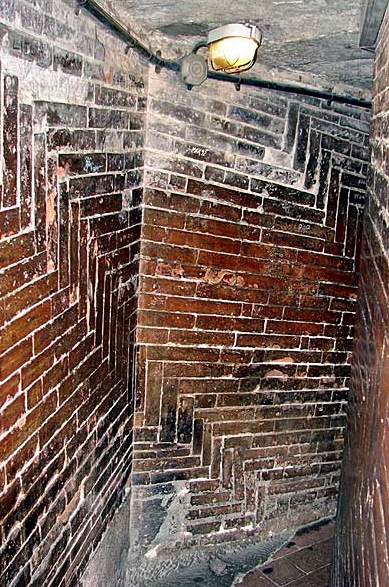
This shows the herringbone pattern
that allowed workers to place bricks
without danger of them falling
from lack of support while the
mortar dried.
The site also explains how he was able to get the bricks on the dome to stay up and not fall to the ground during the construction: “Once again, Brunelleschi had an ingenious idea that is common practice today, but revolutionary in its time. He created a herringbone pattern with the bricks that redirected the weight of the bricks outwards towards the dome’s supports, instead of downwards to the floor. By observing carefully the curve of the dome as it took shape, Brunelleschi was able to place these bricks in key areas.”

Almost to the top.
The last stretch of our trek is the steepest, as we climb stairs that go straight up the curve of the inner shell. Metal hand rails have been added to make this ascent more secure. Once out on the top deck, we enjoy some fabulous 360-degree views of Firenze and the surrounding hills. On the descent, we stop in a room that displays some of the tools that were devised for the dome construction. I have read that Brunellischi become an engineer as well as an architect in order to solve the many construction challenges that arose. He designed new winches, hoists and cranes to bring the materials up, and he had an eye toward the future when he built in storm drainage systems and iron hooks to support interior scaffolding that would be needed later to clean and restore the frescoes.

The dome has withstood weather, earthquakes and time to stand today much as it did upon completion some 600 years ago. The span is 143.5 feet across, still the world’s largest span for a masonry dome. For his achievements, Brunelleschi was accorded the honor of being the only person ever buried in the cathedral, under his ingenious and revolutionary dome. We are awarded tired legs and sore knees, which we gladly bear for the thrill of having been able to view this marvel up close.
What we saw from the top.


Saturday, March 17, 2012

Not only is life beautiful here but death is now hereby forbidden


Thursday, March 15
The crowded cemetery in Carinola.
As much as we like life here in San Salvatore, something I read online makes us discuss moving to a village in Southern Italy which, according to La Stampa, has recently passed an interesting new law. As of March 2, 2012, ordinance 9 prohibits the residents of Falciano del Massico from dying.  Here is the text of the ordinance: “. . . è fatto divieto, per quanto nelle possibilità di ciascuno, ai cittadini residenti o comunque di passaggio di oltrepassare il confine della vita terrena per andare nell'aldilà.” This translates to “. . . it is made forbidden, as much as possible for each person, for residents or whomever to pass beyond the boundaries of life to go to the afterlife.”

Mayor Giulio Cesare Fava explains that the town lacks a cemetery and has been using the one of the comune next door, Carinola. However, the municipalities have been engaging in a big brother-little brother political feud for many years, and as of now, they aren’t speaking to each other. The cemetery has no more room. Fava says Carinola was planning to expand the cemetery, but because of ongoing disagreements, nothing has happened. “It hasn’t started, and we don’t know why,” he says. “They don’t inform us of their acts.”

Fava, who is a cardiologist and thus considered by town residents doubly qualified to enact the new ordinance, wants to see Falciano build its own cemetery to solve the problem, and some Falcianesi have offered their land. But building a proper cemetery will take time and considerable expense, and there will likely be a lawsuit by Carinola, because in the past Falciano had agreed to contribute to the expansion of the Carinola cemetery. In the meantime, Fava says most citizens are pleased with the new law. “The ordinance has brought happiness,” he says. “Some say that the problems were all resolved with a simple administrative act.”

It is well known that Italians love to pass laws to make their lives more orderly, and in principal, the citizens agree with this aspect of Italian culture. However, it is impossible to live within all the laws the government imposes, and this is so in Falciano as well. Fava says two elderly residents have already violated the law, and it looks like these “conscientious objectors” are going to get away with it. The mayor conceded that he is not planning to fine them.

Sources:

Thursday, March 15, 2012

Americans at a lively Italian church


Tuesday, March 13
From our Padova friends Steve and Patti, we are aware of a concert by an American university choir scheduled for tonight, so we lock our bikes at the San Salvatore station and take an 80-minute train trip to Firenze. The group is from Valley Forge Christian College in Pennsylvania, and it is performing at an Italian protestant church, a rarity in Italy.

We arrive promptly at 8 p.m., just as the event starts, and the place is packed, so much so that the foyer behind the meeting room is also full. Ushers immediately recognize us as visitors to the church, though, and we are urged to go inside and stand in the narrow space between the wall and the wooden pews. The evening is about 80 percent concert and 20 percent church service, so the congregation sings a couple of its own songs, and then the Italian pastor speaks for a few minutes and leads the congregation in prayer before introducing the choir.

I estimate there are nearly 400 people here tonight, and I am told that this church is typically bursting at the seams every Sunday. So although protestant churches are uncommon here, this one is doing uncommonly well. I do think that in America, though, the fire inspectors would have something to say about how tightly they pack people in.

This is an Italian Assemblies of God church, which is a denomination separate from American Assemblies of God, although they sometimes work together on projects, as they are with this concert. The worship at this church is lively, which is normal in AG churches everywhere. After the pastor prays, everyone else does too, all at the same time, with enthusiasm and obvious emotion. I can’t help but wonder why churches like this are not more common in Italy, as Italians are noted for being expressive, passionate people who openly display their feelings. It is not unusual to hear Italians singing as they work, and Italian soccer fans are known worldwide for their rabid and insane public behavior.  So why are Italians so serious and sedate in church; why aren’t demonstrative churches like this more popular?

OK, I realize I am asking a question that is too profound to answer simply. I’m sure the reasons are numerous and complex, so I’m not expecting a simple answer. Afterwards I do talk to Randy and Diane, who lead International Christian Fellowship in Firenze, and they explain one major reason: The Catholic Church teaches that all other churches are cults to be avoided under threat of damnation. In fact, I read online that in 2007, Pope Benedict XVI released a document that says Orthodox churches are defective and that other Christian denominations are not true churches.  He maintains that protestant churches are merely ecclesial communities and do not have the “means of salvation.” Diane explains that her members encounter Catholics who have “been taught to cover their ears and run” when protestants to talk about their beliefs.

Well, I don’t want to provoke an argument about religion, so I’ll return to the story. The choir sings almost entirely in English, but the director introduces each song with an explanation of the content, and his words are translated into Italian. The acoustics are excellent and so is the choir. Audience members seem very attentive and appreciative, with many hand-held video cameras recording much of the entire event. The vice president of the college has accompanied the choir, and he gives a 20-minute sermon, all translated into Italian.

Afterwards several people greet us and introduce themselves, and we are given information about the church. Because the trains back to San Salvatore don’t run this late, we are staying overnight with Randy and Diane, but now they explain that they must go to a dinner with the choir. Would we mind staying too? Well, not if there’s dinner involved, of course, since all we brought with us were sandwiches, fruit and cookies, which we ate mid-afternoon.

The dinner has been prepared by members of the church, and it is a scrumptious four-course Italian feast. We have the opportunity to sit with members of the choir and also members of the church, and we feel useful because we can help translate conversations, and we are also able to give the choir members some tips about Italian life. Randy and Diane live about 45 minutes away, so we are among the first to leave. It is around 11:30 p.m. and nobody else is getting up yet, typical of Italian events, but this staying up past midnight is not commonplace for us old fogey Americans, so we are quite ready to hit the sack.

Note: Almost five years after this experience, we found a wonderful evangelical Italian church in Altopascio, near Lucca. It has great worship music and a small but friendly Italian community. Everything is in Italians and there are only two people in the congregation who speak English, but that's OK with us because we want to improve our language skills.
We have stumbled across our church home in nearby Altopascio.

Wednesday, March 14, 2012

Going to mass in San Salvatore


Sunday, March 11
Last year we went to the Valdesian church in Lucca, but today I go to the Catholic church here in San Salvatore. I have decided to give this church a try for several reasons, the first being that it is so much more convenient. It requires a short bike ride instead of a bike ride, train trip to Lucca and another bike ride.

A second reason is more sentimental. This is likely the church attended by my grandparents, and it is probably where they were married. I don’t know this for certain, but it is the only church in San Salvatore and it is right across the street from where Nonno lived, along with his parents Pietro and Maria and brothers Enrico and Eugenio. For Nonna, it would have required a 20-minute walk, but it still would have been the closest church.

A third reason, and this may be wishful thinking, given that I am only here for a short time, is that it will make me more a part of the local community. People who live in San Salvatore have had the same friends since childhood, and though they are not unfriendly, they are not accustomed to inviting stray American strangers into their homes. Seeing me in church for a few Sundays probably won’t make a real difference, but it can’t hurt. I don’t have high expectations on this front, but the reasons of convenience and sentiment are enough for me anyway.

I arrive at 10:59 a.m. and take a seat on the side near the back. Mass begins in one minute and there are only about 30 people present. However, within the next 10 minutes, another 15 have entered. I estimate there are 25 women, 15 men and five children. The walls are adorned with six frescoes of brilliant colors. The style looks traditional in the manner of old churches here, with scenes from the Bible, but I can’t guess how old they are. Did my grandparents gaze at these each Sunday? The vibrancy of the colors makes me wonder if they have not perhaps been created within the last 100 years. My grandparents married in 1908 and left Italy in 1909, though Nonna returned for a visit in 1913. I will have to find out when these frescoes were done.

Mass is not greatly different than it was when I grew up in America. A small choral group sings one song to begin, and there are scripture readings by a lay person and the priest. A printed single-fold bulletin contains commentaries on today’s scriptures and lets us know what to say during the responsive readings. The sermon consists of the priest reading for 10 minutes from a church publication and then 10 minutes of his own thoughts on the same topic, which is Jesus upsetting the stalls of the money changers and vendors in the temple.

I hang around for a few minutes afterwards to snap a few photos. I wouldn’t mind going up to meet the priest and asking him about the frescoes, but he has disappeared into the side vestibule. I leave without talking to anyone, but I will try again in the weeks to come.

Monday, March 12, 2012

Ubiquitous evening passeggiata
a reflection of Italian lifestyle

Saturday, March 10
After going to the cinema in Lucca to take in the afternoon matinee of the French film Intouchables (Quasi Amici is the Italian title), we get some gelato, wander around and take part in the evening passeggiata, one of our favorite parts of life here.

I struggle with words to describe la passeggiata. It is a slow and gentle stroll through the pedestrian parts of the center of any city, usually beginning just before dusk. It signals the end of the work day, offers a breath of fresh air and allows people to chat with friends and neighbors. On weekends whole families walk together, sometimes splitting apart for smaller conversations and then joining together again.

“For townspeople of all ages, the passeggiata reinforces a sense of belonging,” writes Dianne Hales in an article in Fodors.com. “The greeting of friends and acquaintances, the swapping of gossip, and the sharing of the latest news weave everyone into the human fabric of the community.”

I could say that people dress themselves carefully for this stroll, but the fact is that most Italians almost always look good in public. Clothes are stylish but not garish. Colors are coordinated; styles are modern, classy and form-fitting, never faded or sagging. Sweat pants and sweat shirts are virtually non-existent. Yet these people dress in a way that looks natural, effortless. It is another example of sprezzatura.

Sprezzatura in fashion, according to Johnny Liu of style and shopping website Omiru, is “artful dishevelment—dressing like you don’t care, taking a nonchalant attitude with your appearance—when in fact you do take time and effort to create your look. The trick to pulling it off is subtlety, confidence and an otherwise impeccable outfit.”

Because Italians love their
uniforms, even the poliziotti
are well dressed for occasion.
That it does take time and effort to appear effortless is confirmed by Italian author Annalisa Coppolaro-Nowell. “We pay great attention to the way we look and dress,” she writes in her book, How to live like an Italian. “That is why our parties are such a feast for the eyes; even in other countries and cities, if you go to an Italian party, people look beautiful and smart and the décor is usually brilliant.”

Yet it is not the clothing that impresses me as much as the personal interaction. I instantly sense that something is fundamentally different about these people, and as I sit and watch carefully, I notice the way they interact. Many people walk with their arms linked together. Of course this applies to couples of all ages and is not unique to Italy. But it is also common to see teenage girls with linked arms, a sign of close friendship, and teen girls linked to their mothers. Middle-aged women walk with arms linked to their aging mothers. Sometimes sisters walk on either side of a particularly old mother to offer both physical and emotional support.

This closeness is not limited to the women. While it is unusual to see boys walking with linked arms, there still is a physical closeness and comfort with contact not seen in other countries. I see a cluster of boys talking loudly and easily with each other, and one puts his hand on the other’s shoulder and leans closer to share a story he does not want everyone else to hear. It is also possible to see middle-aged men with arms linked to their fathers, and even occasionally a young teen linked with father or mother, something that would be social suicide in America. The closeness of Italian family ties is typically something that people note and admire about Italy, and the passeggiata develops and encourages this trait as well as puts it on display.

While most people walk in groups, those walking by themselves seem perfectly comfortable among the crowd. At a certain age—maybe around 60—men walking on their own adopt what Lucy and I call the old man’s walk, leaning forward slightly, with hands clasped behind their backs. I occasionally practice this myself when walking alone so I will be ready when my time comes.

Gelato and cell
phone are two
important
accessories.
The most interesting to watch are the teenagers and young adults, who perhaps have the most at stake when it comes to making a good impression. This is their chance to strengthen alliances, make new ones and impress the opposite sex. In a way, the passeggiata of young people reminds me middle and high school dances, charged with youthful energy, enthusiasm and passion. Of course this event takes place every night, so the stakes are not so high and the participants more relaxed, experienced and comfortable.

Giovanna Del Negro, in her book The Passeggiata and Culture in an Italian Town, writes that this is “a socially sanctioned opportunity for flirting and courting.” Parents approve, she says, because “the rhetorical skills learned in the piazza become useful in the marriage market, the work place and the complex politics of the town.”

The passeggiata is the place where many romantic relationships begin, according to Mari Accardi, who grew up in Sicily and is now a tour guide with Rick Steves. “A boy may send some glances toward a girl, and if she is interested, she sends some back. Then it's up to the boy to take the next step, to say ciao, ask for her name and see if she wants to get a coffee.

Though I love watching the passeggiata, it sometimes makes me wistful and envious of those who have grown up in Italy. Had I been raised here, maybe I would have developed better social skills as a youth, and then I could be more like the old men who sit around chatting, arguing and playing cards with their lifelong friends. Or at least by now I would have mastered the old man walk.


Saturday, March 10, 2012

More tales of il permesso di soggiorno

Saturday, March 10
We are not the only people who have had difficulty obtaining our permesso di soggiorno. I search this term on the web and find multiple mention of difficult experiences with the questura, although unlike us, most people eventually are successful. Many who write about their experiences have come as students, and they had to purchase student health insurance packages. Apparently this type of assicurazione is more comprehensive than was our unacceptable traveler’s insurance policy.

Photo from Commune di Milano website.
I also find that in 2007, the procedures were changed slightly—I almost said simplified, but they may actually have been made more complicated. Instead of starting out at the questura, now one must start at the post office—not just any post office but one that has a sportello amico, a friend window. Theoretically, this should be an improvement, because the lines at the post offices are somewhat shorter than those at the questura, but there are new procedures to learn when queuing in a post office line. Another thing that sounds better about the new procedure is that after a person correctly submits all forms to the post office, he is given an actual appointment at the questura. However, from all that I have read, the actual hour of the appointment is meaningless, as one still must wait in the questura line based on arrival time, not appointment time.

Of all the forums and blogs about this subject I read, by far the most informative and entertaining is written by Nathan Randall in his blog The adventures of Nataniele Randaglio—Part 2, dated December 1, 2009. Nate has kindly granted me permission to reprint his work.

Here’s what I’ve had to go through in order to get my permesso di soggiorno – a permit of stay, of sorts, that declares my presence in Italy completely legit. The permesso, here, is a nebulous concept. It’s unclear who needs it, how to get it, what it looks like, even. Some say it’s a paper document, others insist it’s more of a plastic card, and even others claim it to be a magical Italian elf that follows you around assuring your legality via interpretive song and dance to those who doubt it.

Step 1: Go to the post office and pick up the application. To do this, you must first wait in line, which you’ll do politely for five and a half minutes, unsure of where the line begins or ends, before remembering that the post offices in Italy require you to push a button on a machine near the doorway that gives you a paper ticket identifying, officially, your place among the other people in line. Actually, a very nice system that helps you avoid those awkward “who got here first?” interactions with strangers. The funny thing, you’ll notice, is that nobody bothers to sit down in the provided chairs to wait their turn. People, it seems, are so used to fighting for spots in such lines that they’ll stand in the post office lobby, clutching their paper tickets with white, angry knuckles and staring anxiously at the neon numbers counting upwards on the NBA-scoreboard-style counter in the center of the office. When it’s finally your turn, you’ll go to the postal worker and ask for the application, only to learn that there are, in fact, several buttons on that paper ticket emitting machine near the doorway, and that you pushed the wrong one and must redo the process. On try number two, you will get it right, go to a different window, and finally receive the documents to proceed.

Step 2: Reading the documents back at school, you’ll see that one of them requires a marca da bollo. Having heard stories from permesso applicants of years past, you’ll already know that a marca da bollo is an official, government-issued stamp that you must purchase not at the post office, where you foolishly assume you would get an official, government-issued stamp, but in fact at one of the tobacco distributors in town. Proud of yourself for being so permesso savvy, you’ll go straight to the tobacco distributor and spend $14.92 on your very own marca da bollo.

Step 3: Once finished filling out the application forms in either black or blue pen, you’ll go to the photocopy room at school to make the as-requested photocopies of your official documents, including, reasonably enough, your passport, which you’ll wisely bring to school with you that morning. Just as you did when you applied for your visa back in the states, you’ll photocopy all of the passport’s relevant pages – that is, the front page with your name and personal information, the page with your visa, and the page with your entrance stamp.

Step 4: All in the same day, you’ll return to the post-office, convinced that you’ll impress the postal workers with your dedication to immigration regulations. You’ll push the right button on your first try, wait (on foot, of course) with everybody else, stare at the NBA-scoreboard-style counter until it’s your turn, and then present both yourself and your well-organized folder of documents to the postal worker. When she gets to your passport photocopies, you’ll mentally notice that you did a really great job choosing an appropriate level of photocopy darkness. So content will you be with your artwork that you won’t realize the postal worker is addressing you.

“Where are the rest of the passport photocopies,” she’ll be saying.

Finally coming to. “What do you mean?”

“You need to photocopy all of the pages.”

“All of the pages?”

“Yes. All of the pages.”

You’ll chew on this for a second. “Even the blank ones at the end”

“Yes. Of course. And the covers as well. Front and back.”

Step 5: You’ll return to the school photocopy room and make photocopies of all 25 pages of your passport and both covers, thanking yourself that at least you have access to free photocopies.

Step 6: Tired of going to the post office in the city where you work, you’ll take a train back to your host family’s house and go to the post office in the city where you live, bringing your completed application, all of your photocopies, a new sense of purpose, and a refusal to give in to the man. As it turns out, the people at this post office will be much friendlier, and after demonstrating your expertise with the ticket emitting button machine, you’ll race through the rest of the process and be granted your first official permesso appointment—scheduled for 8:46am (yes, 8:46am)—at the questura in the province’s capital. In your case, this capital will be located about 40 km away, but you’ll be lucky because your appointment will be scheduled for the one day of the week that you don’t have morning classes.

Step 7: Three weeks later, you’ll hop on an early train to the province’s capital and report to the questura at 8:33 a.m. There, you’ll find a cement lobby, empty of chairs but full of immigrants from all over the world funneling towards the glass doors leading into the immigration office. And this time there will be no ticket emitting button machine, so you’ll have to employ all the skills you learned in middle school lacrosse practices in order to stay on your feet and maintain your ground. Painstakingly slowly, you’ll nudge your way, with the rest of the crowd, towards the tip of the funnel. After an hour of waiting, and gently pushing, and waiting some more, you’ll be at the front of the line, and enter the glass doors. There, you’ll have a young immigration officer so fascinated by your American citizenship that he won’t even look at the documents you’ve worked so hard to prepare, and which have been sent there from the post office you first went to. Rather, he’ll accept them all, rush you through the fingerprinting process (yes, you’ll get fingerprinted), congratulate you on making it through the first step without any hitches, and then give you another appointment for three weeks later, once again at the questura in the capital of your province. Confused, you’ll say:

“Wait. But… sir… you just fingerprinted me. Why do I need to come back for more fingerprints? I’ll have to miss school… and take another train… and waste… I mean… use, not waste, use, an entire day. Can’t I do them now?”

And he’ll say: “No. I’m sorry. Different machine, different fingerprints. Be sure not to miss your appointment.”

Step 8: Defeated, you’ll get a gelato in an attempt to cheer yourself up. (It’ll work pretty well.)

Step 9: Three weeks later, you’ll return to the capital of your province. This time, you’ll get there two hours early and be the first in line. You’ll take more fingerprints, as well as full-fledged palm and hand prints—before being congratulated on having completed the second stage of your permesso di soggiorno. You won’t bother telling the fingerprint technician that this is, in fact, the ninth stage. Instead, you’ll thank him politely, and leave. You'll note that even if you’d had all of the documents that second time you went to the post office, you still would have needed to make six different trips in order to complete the process. The first, to pick up the application. The second to purchase the marca da bollo at the tabacchi. The third to submit everything to the post office. The fourth the go to the questura to go over (for a second time) your documents, and then conduct fingerprints. The fifth time to return to the questura for more finger and hand prints. And the sixth time to pick the finished document up.

Step 10: You’ll go back to your home and blog about the experience so that your friends and family can understand how much incentive the system gives you to seeing these bureaucratic processes through.

Nate’s step 10 is optional, of course, but I’m glad he did it, because his experiences and writing really cracked me up. In a later blog, he took one more trip to the questura and actually picked up his permesso, which was not a magical elf but actually a plastic card, though by this time it was almost time for him to return to the U.S.

In defense of the system, I found another website that says the fingerprinting process is now done in one appointment, and the post office no longer requires that blank pages of the passport be copied. The site also says that you don’t need to wait in line for the packet. You just go to the counter and ask for “il kit del permesso di soggiorno” for non-EU citizens. On the downside, for services rendered, the post office also requires an administrative fee of 27.50 euro, which is in addition to the 14.62 marca da bollo tax and the 30 euro Ministry of Finance charge.
Update 2023: Lucy received her permesso di soggiorno in Lucca in 2017, and in 2023 we went back to the Questura in Lucca to renew it. We did not make an appointment at the post office either time. We just waited in line. The second time, we waited in line at the Questura and were then given an appointment to come back about two weeks later. I do not write to explain the best way to do things in Italy, just to describe our own experiences. And really, the best way to do things in one city may not apply at all in another city.