Monday, April 10, 2023

Our first real Pasquetta in Tuscany

Boating on the Padule on Pasquetta.
For the majority of the past 12 years, Lucy and I have celebrated Easter Sunday while in Tuscany—but this is the first time we really participated in Pasquetta, an important Italian tradition celebrated on the day following Easter. Pasquetta—literally “little Easter”—is a civil holiday, with little of a religious nature. However, some maintain that it is celebrated with an almost religious fervor because it is so deeply ingrained in the culture. Traditionally, it is a day for Italian families to venture into the countryside for a day of picnics and outdoor fun. Most factories and stores are closed, though many restaurants remain open.


The reason we’ve not celebrated Pasquetta is that our family here consists of just Lucy and me. True, I have a large extended family in Tuscany, but Pasquetta celebrations usually involve the nuclear family. My closest relatives are third cousins, and even then, I’ve only known them for a few years, so we’ve never really been involved in this important tradition beyond watching families meander down the picturesque streets of Montecarlo.

The difference this year is that we went to an advertised event called Pasquetta in Padule at the Casotto del Sordo near Massarella. Because of my affection for the Padule di Fucecchio, I had ridden my bike to the Casotto del Sordo about a week ago, not really knowing what to expect. To me, it had basically been just a dot on the map on the edge of the Padule. I have since learned that this little shack was built in 1923 by a man who had returned badly injured from World War 1. Among his injuries, he had lost his hearing and had been given the nickname Il Sordo, meaning “the deaf.” Now the Casotto is managed by an association of hunters, fishermen, landowners and local residents concerned with maintaining and improving the ambiance of the Padule. This swamp had once been a vital source of sustenance for the community, but in the later 1900s, it became somewhat of a dumping ground. Now there are several associations committed to cleaning it up and helping the public understand its importance to the ecosystem.

The Association Il Padule sponsored the Pasquetta event, which included food, drinks, scenic walks and boat rides. The group has built several other buildings adjoining the Casotto that were used for the preparation and sale of the food, and members have also added a covered outdoor eating area with picnic tables and benches. When we arrived in mid-afternoon, the parking lot was nearly full, and some 200 people were picnicking, lounging in the grass, playing football and volleyball, walking on the shores of the Padule, and lining up for rides in the barchini, which are small boats piloted by members of the association. Lucy and I took a stroll down to the canal while we watched ducks swimming and a number of large white and gray birds flying by. I wish I could say what the birds were, but I’m not great at recognizing bird species, especially in a country where I was not raised.

Not my photo, but this is a Pittima Raela,
taken in the Padule. Photo by Enrico di Gregorio.
I read online that bird watchers and biologists performed a study of the Padule during Covid times. I used Google to translate a portion of the report: “39 species were recorded (a true biodiversity record) for a total number of 12,783 birds, among which the Alzavole (6,012) stand out, the rare Ibis (234), the Pavoncella (1455) and the Moriglione (749). There have been sightings of rare species such as the Bittern, the White Stork, the Spoonbill, the Flamingo and the Ferruginous Duck, and for the first time a small group of wintering night herons was also found (25).” Most of these birds are not found where I grew up in Western Washington, so I don’t feel so bad for not recognizing them.

Ciaccini and espresso
We did not pay for a boat ride this time, but it is now on our list for future adventures. We did sample a very regional snack named ciaccini, something we’ve never heard of before. I spoke to one of the volunteers, who confirmed that while it exists in other regions, it would be called something else. A ciaccino consisted of a very thin and round slice of fried dough, about the size of a pancake, seasoned with salt, olive oil and perhaps a few spices. For 3 euro, we each received two ciaccini affettato (with finely sliced prosciutto between them). Probably the most enjoyable part of the afternoon was the people-watching we did while eating and enjoying our tiny cups of espresso—old men standing close together while swapping tales; men, women, boys and girls playing calcio; little boys beating stalks of bamboo with wooden sticks; families dining and boating together; girls running and screaming; couples walking hand-in-hand. I have little doubt that we were the only non-Italians in the group, and that’s just fine with us. This is why we come here—to experience the Italian lifestyle that exists far from the touristy cities. For us, now, Pasquetta is more than just a word.


Wednesday, April 5, 2023

Day trip to Pesciatina Svizzera: A favorite activity worth repeating

Someday I need to write a complete blog or even a magazine article about the Valleriana and the 10 castle cities located there, but for today, a brief mention will have to do. This valley, also called Pesciatina Svizzera because of its resemblance to the Swiss Alps, draws us back again and again. It is especially appealing to visit on a clear day like today.

Historically referred to as Valle Ariana but later shortened to Valleriana, the valley rises up from an elevation of about 200 feet above sea level in Pescia to the highest town of Pontito at 2,444 feet. At various places along the way, one can view many of the picturesque cities, also called castles because most cities were walled during medieval times, and the entire city was referred to as a castle. Before today, Lucy and I had only visited three of the cities, but now we’ve added a fourth to the list, Castelvecchio.


We picked up our friends Kjetil and Laila around 11 a.m. and arrived in Castelvecchio a little before noon. We took a step back in time while taking a half hour stroll through the sloped and slanted stone streets, admiring red tiled roofs, an amazing variety of doors—both ancient and modern—and the patchwork stone and brick walls of homes built mostly between 1300 and 1900. We saw tidy homes with neatly kept yards scattered among homes and yards that were crumbling ruins. The most recent census shows 146 inhabitants, but one can imagine that during better times the city housed up to 1,000 residents, many of whom went out of the city during the daytime to hunt in the woods, gather chestnuts or work in their hillside farms.

Some traveled even farther down the valley to work in the numerous paper mills that were powered by the current of the river Pescia. Production of paper in this area began in the late 1400s and reached its peak in the 1800s because of the valley’s strategic location near both the mountains above and thriving centers of commerce such as Lucca, Pistoia, Montecatini and Florence on the plains below.

Of the cities we’ve visited, we can’t really pick a favorite. They’re all fabulous, really. Pontito is the highest and one of the least populated (50 inhabitants), so if you want to see a particularly peaceful and weather-worn village, it’s the place to go. Vellano is the largest, with a population around 270, and it has the most activity, including a mining museum, a popular annual festa to celebrate chestnut snacks, and the highly regarded Trattoria Manero. We’ve also been to San Quirico, population 200, which is no less interesting and beautiful than the others.

Pontito taken from below.
I forgot my camera in the car, but Kjetil took some great photos, and I have borrowed some to post here. After our stroll, we went to La Pieve, one of my personal favorite restaurants. It has a pranzo di lavoro, in which customers can enjoy a complete lunch for 13 euro (prior to Covid, it was only 11 euro). Though relatively remote, the place was packed, more so today than other times we’ve dined here. Despite the crowd, service was prompt. We enjoyed a leisurely meal in good company. And with six more castle cities to explore in the coming years, we’ll surely be back for more sightseeing and dining pleasure.

Pranzo at La Pieve.


Sunday, April 2, 2023

Another encounter with the carabinieri

My plan to avoid getting my Italian driver’s license was put to the test today—the second time this has happened. Coming back from church in Altopascio, we were waved to the side of the road by two impeccably attired and stone-faced carabinieri. I knew what they wanted: documents for my identity and the car’s registration papers.

Normally when we have a car here, it’s from a rental agency, but this time we are using a car loaned by our friend Simone and Luciano, his dad. Luciano spends much of his time out of the country, so his car would otherwise be sitting in a dank garage. We can attest to that because that’s where it was when Simone took us to pick it up, with some white mold starting to bloom on the leather fixtures. Of course, we’ve cleaned that off and given the car a good airing. We had previously planned to get by for most of our stay with just our bikes this spring, but the car has been a real Godsend. After all, just because we’re in Tuscany doesn’t mean that it’s never cold and rainy.

Rolling down the window and unfastening my seatbelt, I pulled out my wallet and handed over my Washington state driver’s license and my international permit while speaking mostly in English. I had to fumble through the pile of papers in the glove box to find the car’s registration papers, but I found them with only a short delay. I should also have been carrying my American passport, but I told the carabiniere I had left it in my room, which is the truth. While he went back to his car, presumably to do a computer check on the car and write up a report, I had Lucy pull up on her phone the document Simone had sent us granting permission to use the car. As the officer walked back to us, perhaps to ask why I was driving a car owned by someone else, I held up the phone so he could read it. Then he went back to his car and added more to his report.

After another couple of minutes, he handed me back my license and said all was okay, crossing his chest to indicate that I should refasten my seat belt. Only as we pulled away did he give us a slight smile. I was last pulled over in 2017, and the routine was much the same, only that time I had a rental car and the carabinieri were a little more chatty, although just as efficient and professional as the ones we dealt with today.

You may wonder why I spoke of a plan to avoid getting an Italian license. Well, it’s a big deal for people who have sold their homes in America to live in Italy full time. Legally, they have only one year to get an Italian license, and that can be a daunting task. The tests, both written and verbal, are conducted entirely in Italian. I have the advantage of only living here for a few months at a time, meaning I can keep my U.S. license current and pass as a tourist. For a more detailed explanation of the legal situation, you can read the details of my traffic stop in 2017: Stopped by the Italian police.

Friday, March 31, 2023

A peaceful visit to the hillside Rocca above nearby Villa Basilica

We keep finding new favorite places here. Wednesday it was the Rocca di Villa Basilica, something that I had not heard of despite it being only 16 kilometers away, and it is basically visible from Montecarlo. This destination was suggested to us by Renzo Tori, a local bicycling enthusiast and poet who often posts scenic photos and poems on his Facebook page. As Wednesday was too cold for me to go for a bike ride, we hopped into our borrowed car and headed out on a dry but mostly overcast day. Our gps said it would be a 22-minute drive.

While Lucy and I had been to centro storico of Villa Basilica once before, we didn’t realize that just above the town is an abandoned stone fortress built in the 12th century. A rocca (literally, rock) is a type of Italian fortified stronghold, typically located on a hilltop, beneath or on which the inhabitants of a village or town might take refuge in times of trouble. We passed Collodi and headed up the valley, winding back and forth on sharp switchbacks once we reached Botticino. This would have been a challenge on my bike, even with the electric power boost. While there is a road all the way to the fortress, the last 200 meters looked a bit challenging for our car, so we parked and walked in.

I managed breach the defenses.
We enjoyed the vista for about 15 minutes—both the view of the Rocca and the view from it. We were the only ones there, and the fortress gate was locked, but we figured that was only a suggestion. If a fence can be scaled in two seconds by a 70-year-old man, it must have been designed with that in mind. Inside I found a rectangular cistern partially filled with rain water, and a wooden platform that looked like it could be used for a band or theater group in summer months. I climbed a wooden ramp that led to the circular lookout tower and tried to imagine being here 700 years ago while preparing my weapons to hold off advancing enemies.

We had a birds-eye view of Villa Basilica, and in the distance to the south, we saw Montecarlo—the fortress, the church tower and the two trees that are right outside our house. Looking north, we saw the isolated hillside village of Pariana. What must it have been like to live in one of these villages during the Middle Ages and Renaissance, when it would have taken two and a half hours to walk uphill from Pescia to Villa Basilica, and another two hours to Pariana? It’s fun to imagine. But then again, maybe not so fun to have been here when the village bounced back and forth between the warring kingdoms of Lucca, Florence and Pisa. The Rocca and village were sacked several times in the late 1300s and early 1400s. The city was burned, and the inhabitants killed, imprisoned or driven away at least three times in a period of 100 years. I think I prefer the isolation and quiet that Lucy and I experienced there today.


Wednesday, March 29, 2023

Praise for the picturesque Padule

Yesterday’s bike ride took me to the Padule di Fucecchio, Italy’s largest swamp. What a treasure this place is! I parked my bike at the Casotto (or Casin) di Lillo and walked down what was labeled a percorso didattico, a teaching trail. I had hoped there would be some signs telling me about the flora and fauna, but no luck. Probably the teaching is normally done by an experienced guide, but I had none.

However, I did see about 200 herons and egrets, all at the same time gathered in a cluster of trees, raising a huge racket. Startled turtles plunged into the canals just ahead of me. Fingerling fish by the hundreds of thousands flitted on the edges of every canal, and the water glistened and reflected the pristine blue Tuscan sky heavenward.

As much as Italy is renowned for its stunning man-made paintings, sculptures and architecture, I still prefer the God-made art. I’m admittedly in the minority, as I was the only person in the park at the Casotto (or Casin) di Lillo from 3-4:30 p.m. Despite people in Italy being pretty environmentally conscious, I found a stagnant part of one of the canals choked by both naturally occurring and man-made garbage. Come on, people! Still, my walk was 99 percent gorgeous.

Well, not 100% beautiful.
On the ride back, I worried that my bike would run out of power. As I left the park, it dropped to three bars (out of five), and I vaguely remembered that the one time I did run out of power last fall; it had gone to one bar and then died almost immediately. I had used two bars to get to the Padule, and if it took me two bars to get to San Salvatore (the bottom of the hill), I’d be on one bar starting up the long hill and could be stuck pushing a heavy bike up the very steep last two kilometers.

When I reached Chiesanuova, it looked like my meter had dropped to two bars, and I panicked and switched off the power and pedaled on in manual mode. I wanted to have two bars when I started up the hill, and I was still two kilometers from San Salvatore. Whoa, I slowed to the pace of a walk, albeit a brisk one, but it definitely took more effort than walking. That bike is heavy! But as I came to the outskirts of San Salvatore, I pulled over and switched the power back on. Three bars! The battery must have recharged slightly, I thought, but nope, it stayed on three bars all the way home. I think what happened is that I had misread the gauge because I had my dark glasses on and not my reading glasses. Had I pulled over and looked more closely at the gauge before cutting the power, I would have been fine. Lesson learned, with the added benefit of getting a more thorough workout. I just hope that no one reads this and sees how stupid I was!


Monday, March 27, 2023

More bike riding under the Tuscan sun

Last fall I wrote a blog on why I love bike riding in Tuscany, so I shouldn’t be writing another one so soon—but I just can’t help it! With the temperature in the high 60s and the sun shining brightly, I took two rides today, a short one to Altopascio in the morning on an errand, and then a longer pleasure trip to Tofori in the afternoon.

Looking south from Tofori towards Montecarlo and Montechiari.
Elation floods my senses from the combination of freedom, beauty, independence and serenity. My Italwin electric-boost bike glides quietly and effortlessly over the multitude of little-trafficked backroads in the Valdinievole. On my hour-long afternoon ride, I encountered fewer than a dozen cars, with the exception of a half kilometer stretch on the moderately busy via Pesciatina that I needed to traverse to get from Gragnano to via San Gennaro. Starting from Montecarlo, I took the road northwest to San Martino in Colle, passed the Quercione and continued on to Gragnano. Once I left via Pesciatina, it was all uphill to Tofori, an elevation increase of about 220 meters in 3.5 kilometers, but with the power from my e-bike, I never broke a sweat. And what goes up must go down, but oh so quickly and effortlessly.

Wild flowers in Gragnano.
I glided past twisted grape vines, rolling hills of olive groves and numerous multitextured and ancient stone-and-brick buildings, some of them more than 600 years old. Many of the roads are rough, as they consist of asphalt placed directly over ancient mule and cart paths that were carved out centuries ago. With minimal grading and no placement of gravel sub-base prior to the paving, these hillside roads are subject to settling and development of potholes, and only minimal efforts are made to modernize them.

A hazel dormouse!
On my return trip, I pulled off on an off-shooting dirt trail and followed it over a tiny brook, until it became too rough to continue. I stopped to admire the wildflowers and towering oaks, and to just soak in the silence, broken only by the songs of wild birds. I even found what looked like a cross between a mouse and a ground squirrel hiding in the weeds. Thanks to some online help from our friend Wendy, I later identified it as a hazel dormouse. I've not seen a mouse with a bushy tail before. I mentally filed the location away as another great place for a picnic with my wife and a nap on a warm summer day.

Oak trees in the sunshine in Gragnano.


Wednesday, March 22, 2023

Our home has been blessed by the Montecarlo parish priest

We experienced a first today: We had our home blessed by the parish priest of Montecarlo, don Lorenzo Battioli. I had read that this was an Italian tradition during springtime, and a letter from don Lorenzo had been put in our mailbox about a week ago with a schedule stating that he would be offering blessings to homes on via Roma this afternoon.

I had neglected to note this on our calendar, and it was only because of the providence of God that we were home. We had scheduled an appointment at the massage parlor for Lucy this afternoon, but because of some confusion about the time (our fault—we don’t want to talk about it!), I had just called to reschedule it for the next day.

Don Lorenzo
(photo from noitv.it)
At about 4 p.m., our doorbell rang, and Lucy looked out the window. Below was the priest and another man, probably a lay volunteer. I had been reading on the couch and had dozed off. Lucy asked me what she should tell them. I fought a brief internal battle with my innate shyness and the adventurous side of my nature that had compelled me to buy a home in Italy. The latter side won out, thankfully.

We went down to greet them, introduce ourselves and invite them up. The man with don Lorenzo introduced himself as Claudio Donatini, and as is a common experience, he said he was related to a Spadoni through a marriage between a Capocchi and a Spadoni. I told him my great grandmother was a Capocchi, so we undoubtedly have a common ancestor somewhere. This is not at all unusual here. Indeed, I’d estimate more than half the people in Montecarlo are related if only we had complete records dating back 800 years.

We bowed our heads, and don Lorenzo recited a short prayer and sprinkled holy water before he shook our hands and went on his way to the next house. He and I have passed on the street several times, and while each of us knew who the other was, we had never formally met, so this was another small but important step in our slow integration into the community.

Now fully awake, I suggested to Lucy that we take advantage of the remaining daylight and take a walk on a trail that I had noted last fall. It had looked a little too rough to negotiate on my bike, but I had kept it in mind. We drove to the cemetery and then walked for 10-15 minutes down the hillside, first past tall oaks, then groves of olive trees, and then more oaks. We found an open grass field with benches, where we sat and enjoyed a view of the hills on the other side of the Valdinievole. One of the towns clearly visible was Stignano, where my Spadoni ancestors lived from around 1490 to 1630. We filed this away as a great place to come for a picnic lunch during warmer weather. Anybody want to meet us here?


Sunday, March 19, 2023

Back to the slow life of Montecarlo--just the way we want it to be

It’s been about two weeks since we arrived back in Italy, and only a few things have happened worth writing about.

For the first time, we were asked by the police for identity documents in a random check while we were sitting on a train. I had heard that this sometimes happens, and we showed our American passports. We could have used our Italian carte d’identità, but I’m always a little self-conscious about identifying as Italian because of my lack of fluency. I’d rather be complimented for speaking Italian well considering I’m a foreigner as opposed to coming across as a poorly educated Italian.

Piazza San Marco, Venezia
Every time we arrive in Montecarlo, I hold my breath while checking the mail, wondering if there will be a new letter from the Agenzia delle Entrate demanding I pay taxes incurred by someone who has assumed my Italian identity. As far as I know, the AE still thinks I owe nearly 1,000 euro in auto and phone taxes for purchases that took place in other cities almost 10 years ago. I filed a police report, called a denuncia, denying responsibility for these taxes, and I haven’t heard from the AE since. Whether this is because they actually received, read and believed my denuncia or whether my supposed transgression has been buried in a blizzard of bureaucratic inefficiency I may never know. In any event, there was no new letter demanding payment, and I tend to lean toward the latter explanation.

We found our home here to be in great shape after being away for almost four months—no broken water lines, no strange odors, no mold on the walls, all appliances working fine. Even the cold water tap in the bathroom had somehow healed itself. During the previous year, only small drips of water came out when we turned the faucet on, presumably caused by a buildup of calcare—calcium—which is a common problem in Italy. For some unknown reason, now it flows perfectly. This just validates one of my life philosophies learned while reading Peanuts in my childhood. Linus once said, “Learning to ignore things is one of the great paths to inner peace.” However, I should add a disclaimer that I only apply this to the minor annoyances of life. I once shared this concept with my son Randall when he was in grade school, and he used it as an excuse for not starting a major project—and then he told his teacher that he learned this from his dad!


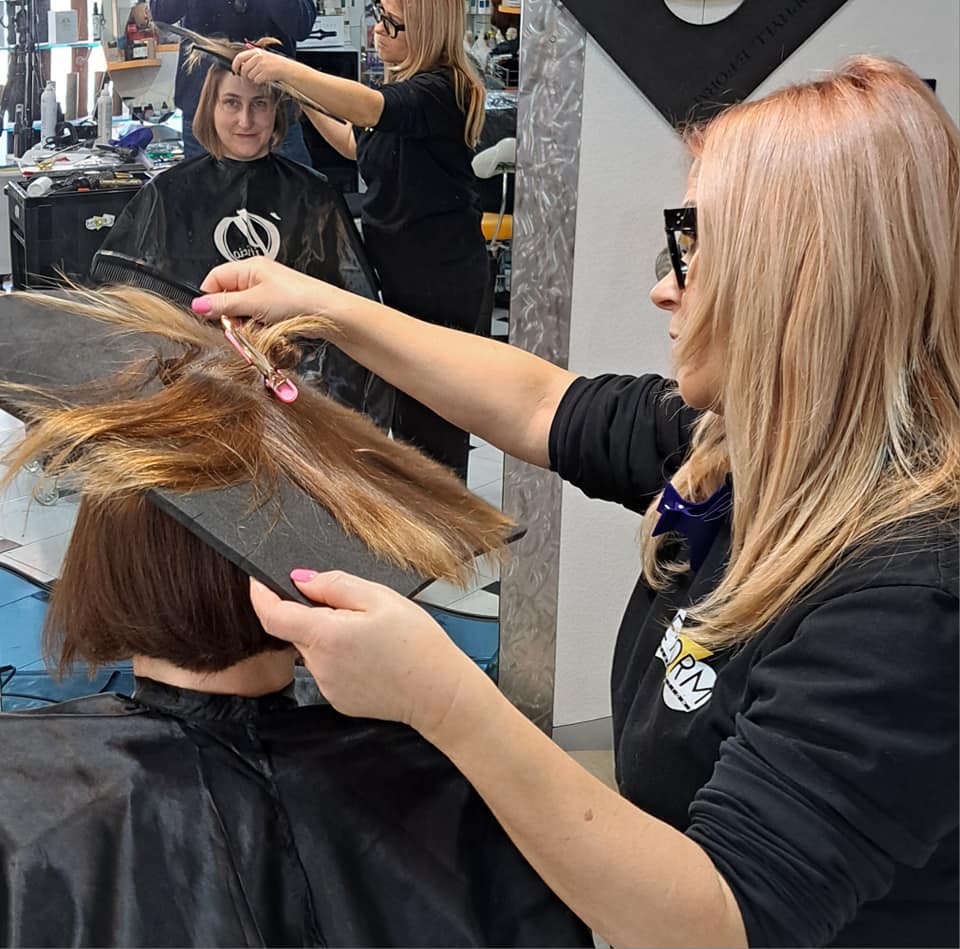
Claudia and Sauro cut and colored Sandy's hair

After a leisurely week recovering from jetlag, we took a two-day trip to Venezia to enjoy some explorations with Dan and Sandra and their kids, who were on spring vacation from school in Nigeria. March is the perfect time of year to be in La Serenissima, as the crowds are low and the weather just starting to warm up. A few days later, we all enjoyed some time together in Montecarlo. Sandra, Clara and Juniper got haircuts from Magic Hair and cousin Sauro, and we picked up Italian citizenship documents for Josie and Ferhan in Pescia. We also took a nice drive into the Apuan Alps to Pizzorne for a picnic lunch and short hike.

We played football and threw the Aerobie in the Altopiano delle Pizzorne.

In a stroke of good fortune, our former exchange student Simone and his dad Luciano offered to loan us Luciano’s car for the next two months. We had planned to get around only on our electric bikes for most of the time, but even though spring is drawing near, it’s still chilly and rainy here about half of the time, today included. We wouldn’t have gone to church this morning without the car.

Clara & Junie at the park in Pizzorne
Now we’re settled in and have no specific plans for the next month. We’ve said many times that we don’t come to Italy to be tourists. We are just here to be. We want to be as Italian as possible, living the slow life, enjoying the cuisine, learning the language, mixing with the locals. We know that we will never be anything close to truly being Italian, but that won’t stop us from trying, from enjoying the process. Norman Vincent Peale once said, “Shoot for the moon. Even if you miss, you’ll land among the stars.”


Monday, March 6, 2023

A fun but non-scary suspension foot bridge in the province of Pistoia

After having crossed the frightening 227-meter long and 120-meter tall swaying Ponte alla Luna in Southern Italy in the fall of 2021, Lucy and I jumped at the chance to cross another narrow pedestrian bridge closer to home this winter. I recently read online about a bridge located about an hour north of Montecarlo, in the comune of San Marcello Piteglio, and we knew right away we had to experience it. The fact that it was free made it even more appealing.

Compared to the Ponte
alla Luna, the Ferriere
is not at all scary.

We had flown into Firenze on Thursday and had a rental car reserved for four days, so there was no time to waste. We left early Saturday morning on a brilliant sunny day, choosing the most winding and scenic route of the three options offered by Google maps. Weaving back and forth on the almost single-wide roads of the Appennini mountains, we passed deep forests of chestnut trees still bare from the winter. We stopped briefly to watch parents and children sledding in a large, sloping field of snow not yet completely melted.

The Lima, as viewed from the bridge.
A few kilometers from San Marcello, we saw a sign directing us to the Ponte Sospeso delle Ferriere, which passes over the Lima river, and we easily found a parking space right next to the entrance. The bridge was only a five-minute walk. Since this is still the low season, we encountered only one other couple on the bridge.

We learned from the interpretive signage that the Ponte Sospeso for many years had been the longest pedestrian suspension bridge in Italy. It had been built in the early 1920s not as a tourist attraction but as a way for metal workers to reach their factory more easily, saving them from what otherwise would have been a six-kilometer daily commute. To cross the bridge takes less than 10 minutes, though for us it took 15 minutes, as we paused to enjoy the scenery and take photos.

Looking upstream at the Lima and beyond into the Appennini mountain range.

Though the bridge is 227 meters long and reaches a height of 36 meters (118 feet), it is not frightening to cross—at least not compared to the modern Tibetan-style pedestrian bridges being built in other mountainous areas of Italy as tourist attractions. Its floor is a continuous grid, and the sides are high enough that there is no possibility of falling off. The Ponte alla Luna, on the other hand, has undoubtedly been built to attract tourists not only by its height but also because it seems dangerous (although it really isn’t), with open sides and floor rungs separated by large gaps.

When the Ponte Sospeso was built 100 years ago, it had wooden flooring, but now pretty much every part has been replaced and improved, making it completely safe. It doesn’t even sway very much, so it’s not particularly exciting for thrill seekers. However, the setting and view are very pleasing, and the price is unbeatable.

Chestnut forest in the Appennini.

On the return drive, we couldn’t resist stopping at a bar in Prunetta with the appealing name Crema e Cioccolato. Yum! I had a slice of chocolate and cream pie and a cappuccino, and Lucy enjoyed a chocolate covered donut washed down with a thick and creamy Italian hot chocolate. Literally, la dolce vita!


Saturday, November 5, 2022

Bike riding in Tuscany opens up new cultural sights and experiences

I was not born to be a runner, swimmer, weightlifter—and especially not a tri-athlete—because I really don’t like any activity that causes me pain or discomfort. In high school, I tried out for the wrestling team—for a single day. And then the same for the swimming team. My comment after quitting both was something like, “If I’m going to work that hard, I at least want to get paid.” On the other hand, I love playing baseball, basketball and volleyball, for the simple reason that I get lost in the joy of competition, camaraderie, teamwork and a focus on the required skills, so much so I don’t even notice that my body is being tested to the limits of its endurance.

We see this activity on nearly every street in the fall.
Bike riding might seem similar to those more painful sports, but against the odds, it has become one of my favorite activities during the months we live in Italy. It’s not that I’ve changed, because I haven’t, but riding on my e-bike in Tuscany requires so little effort and offers so many rewards that I scarcely consider it to be exercise. Because so much of the area surrounding the hill of Montecarlo is level, it was not even very difficult to ride on our old mono speed bikes. Indeed, Lucy and I often rode around just for fun during the years we lived at the Casolare dei Fiori in San Salvatore. But in 2015, we moved up the hill to Montecarlo, and after that we rarely used our old bikes because it was impossible to ride them back up the hill, and it took nearly half an hour to push them up. We just rented a car and left our bikes to gather dust in the closet.
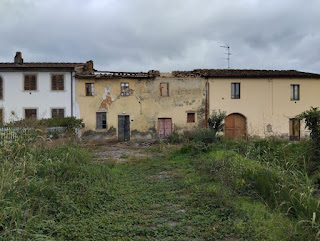
Collapsing houses are a common sight, as it
is often less expensive to build a new house
than it is to remodel an old one.
A year ago, we bought two gently used electric boost bikes, and now I want to go riding pretty much every day. I can fly down the hill at 45 kph, ride for a couple of hours and then make it back up the hill at 15 kph, all the while barely breaking a sweat. Once down on the plains, I find a plethora of little used country roads leading in all directions. Pescia and Altopascio are just 15 minutes away. This week I rode all the way to Lucca in 45 minutes. Google maps said it would take about 70 minutes by bike, but apparently their formula didn’t take into account that the first six kilometers were mostly downhill, or that I would be going on an e-bike. I’m sure it would have taken longer to return, but I took the train back as far as Altopascio, so I’ll have to wait for another day to test the return time.

What do I love about riding in Tuscany? Well, first off, it is Tuscany, and that word alone should be self-explanatory. Just tossing out the word Tuscany sells books, wine, cheese, steak, ham and of course vacation bliss—all for good reason. It’s one of the most beautiful and famous regions in one of the most visited countries in the world. The weather this fall has been unseasonably warm, even for Tuscany, so I have continued to go riding almost every day.

Today is sunny with a high of 68f/20c, a little colder than the previous month but still ideal. Lucy has been busy all week making a quilt, so I took off by myself in the direction of Capannori, with the idea that I might make it to the Torre degli Spadoni. It was almost 3 p.m. when I left the house, and it gets dark now around 5 p.m., so I wasn’t sure I’d make it all the way, but the destination was not as important as the ride itself.
An almost unknown--and underfunded--park
that I rode past in Capannori 
In my younger days—much younger—I used to love riding motorcycles. I started on a Honda 150, moved to a Ducati 350 and then upgraded to a Triumph 650 Bonneville. None of these proved very useful once I married and had the pleasure of raising four kids, so these bikes are only fond memories now, but riding an e-bike is helping me make new memories. A bicycle is almost soundless, so I can hear songs of the birds, the whir of the olive harvesting tools and even catch snippets of conversation among the families working in their fields. I see abandoned, ruined and collapsing farmhouses, signs that farming was once the backbone of the local economy. It still is, to a lesser extent, but I also see many factories that produce paper, plastics, textiles, machinery, fertilizer, glass, chemicals and a variety of other industrial age products. I also see numerous orti—backyard vegetable gardens—and, of course, endless fields of grape vines and olive trees, as wine and olive oil are still important industries.

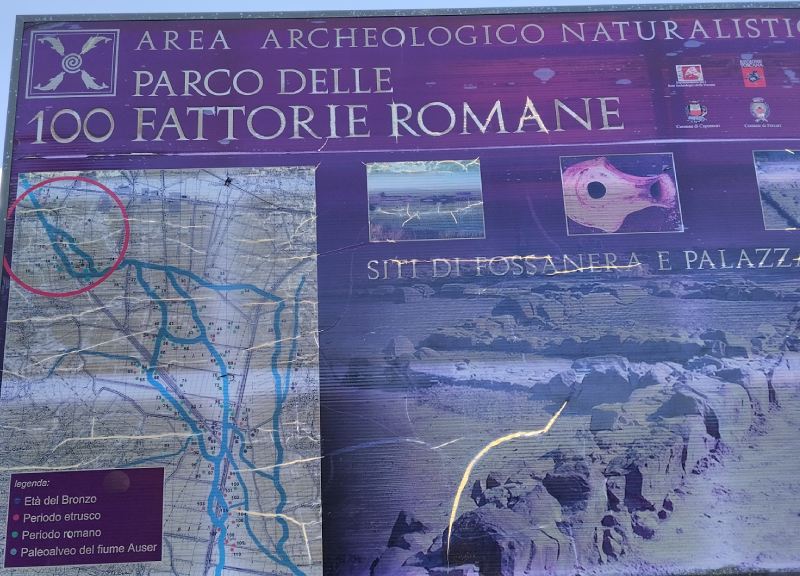
I didn’t make it to the tower, but I made two discoveries along the way that proved even more interesting. The first was an archeological site called the Park of the 100 Roman Farms, basically in the middle of nowhere. I didn’t have time to explore it, but later in the day I looked it up online. The excavations were begun in 1987, and in 2004 the first of many Roman farms was uncovered, with intact tools for making wine and olive oil. However, I also found an article on the website “Toscana Nascosta” explaining that promised funding for continued exploration and displays for visitors never reached the archeologists, and the site, which could be a valuable “economic and tourism resource” was nothing but “a waste of money.” The article also says that a unique oak wood temple of Dionysus was also found in the same general area, but plans for a museum focusing on this discovery have also stalled for lack of funding.

I may go back to see the ruins of the farms on Monday, though I don’t hold hope that I’ll find much worth seeing. Hopefully in future years, funding can be allocated and further explorations will be made and displayed. It’s part of an ongoing problem in Italy, because historical ruins are abundant, but money is not.
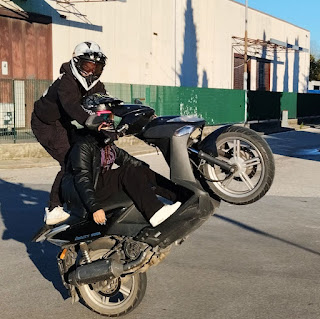
Two riders doing a wheelie.
I was probably only 10 minutes away from reaching the Spadoni tower when I took a wrong turn on a route that Google maps showed to be a through street when in fact it was blocked by fences from a factory. However, I found something equally interesting on the dead-end street. About 40 young adults and teenagers had gathered in a parking lot, many of them with scooters and motorcycles. They were taking turns buzzing along the unused street pulling wheelies and performing acrobatic stunts. Mesmerized, I stopped to watch and take photos for about 15 minutes, astounded at the skills of these riders. They could ride the length of the street with their bikes in a vertical position, a delicate balance requiring just the right amount of acceleration to keep them upright without flipping over backwards. Some of them were actually standing on their bike seats while doing the wheelies.
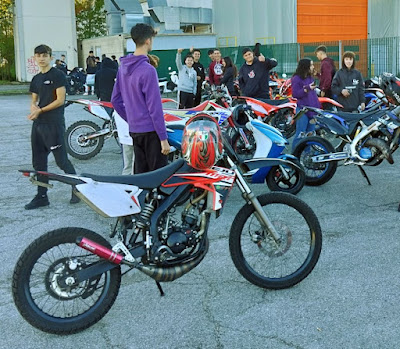
I found this very friendly and talented "gang' of bikers just
hanging out, socializing and practicing their tricks.
I was approached twice by a couple of guys, who asked me, “Ti diamo fastidio?” Are we annoying you? “Ma dai, ragazzi, siete fantastici!” I said. You’re amazing! I told them that I once had a Ducati when I was young. I also used to stand on my seat, but there is no way I could have done the tricks they were doing. I asked if this was an organized group. They said no, it’s just a group of friends, male and female, who gather every Saturday, weather permitting, to socialize and show off their skills. I could have watched for another 15 minutes, but I was worried about getting home before dark. I hope to return some Saturday next spring to enjoy the show again. This is something you’ll never find in a tour book—it can only be found while riding quietly through the Tuscan countryside.