Saturday, January 15, 2022

The aftermath: With his health failing, Sohrweide had to sell his land

Chapter 5, The Old Goat Man of Rosedale

Having a pension allowed Sohrweide to experience his later life on his own terms, but this freedom came to an end when he became bedridden in 1962, not long after he had moved into his new cabin built with Spadoni lumber and labor. It is probably around this time that Greg remembers visiting Sohrweide with my grandfather, John Wagoner. When his illness continued, the 87-year-old recluse had to check into a Tacoma hospital for medical care, and he was later transferred to a nursing home. It is probable, though not certain, that Grampy was the one who took Sohrweide to the hospital.

In May of 1962, Wagoner died of a heart attack, depriving Sohrweide of his good friend and benefactor. We occasionally received reports on his health from Borghild Anderson, who may have been the only Rosedale neighbor who visited him in the final seven years of his life. He passed away at age 93 on March 7, 1969, and is buried in the Rosedale Cemetery.

Dorothy Sohrweide Oliver
His daughter Dorothy made several trips to Washington to visit and deal with the financial realities of her father’s need for medical care in his final years. Dorothy passed away childless in 1997, and her brother Leroy died in 1972. In 2020, I was able to contact Richard Sohrweide, Leroy’s son. Richard had never met his grandfather and knew little about him.

“I heard he was a cranky old cuss,” he said. “I don’t know what the situation was with the family, but I know there were some pretty bad feelings. I don’t know much about the family history, having left home at 17 to join the Navy, which I retired from in 1970. Dad never told me anything about my grandfather. What little that I do know I got from my grandmother and my aunt Dorothy.

Richard Sohrweide
“I can remember when he was ailing and about to die. Dorothy was taking care of him when he was getting pretty bad. To the best of my knowledge, we never got any mail from him, and he never visited my dad and my dad never visited him. About all I know about the man is that he had some property in Gig Harbor and he had some goats.”

To pay for her father’s medical care, Dorothy turned to the Rosedale community for help to find a supposed cache of money that Raynard had left on the property. It was either in a jar buried beside a maple tree or in a bag in the crotch of the tree—our memories of the details differ—but many of us remember a neighborhood search party looking for the right tree and the money. Whether the cash was a fabrication of the failing mind of an old man or it was true, the money never materialized.

In later years, Roy Spadoni’s daughter Annette and her husband Frank Bannon built a home and large garage about where Sohrweide’s shack had been.  “I never met Mr. Sohrweide,” Annette said, “but we were told that when we turned over dirt, to look for his jar of money.” In the process of building and gardening, she added: “We’ve turned over pretty much every bit of dirt on this land and didn’t find it.”

Dorothy and her husband
Alma VanFleet
With only Sohrweide’s presumably modest union pension available to cover medical expenses, Dorothy had to put his property on the market. It was purchased by a group that consisted of the four Spadoni brothers and their three sisters, along with all their spouses, who formed a partnership called Shorecrest. They moved Ray Nash Drive inland about 100 feet to create a row of waterfront lots, and they installed a community septic system with a drainfield in the northeast corner. They also logged and cleared the land and installed some gravel roads.

At that point, the development stalled for need of additional financing. Some of the investors wanted to continue, and some wanted to cash out their investment. A decision was made to sell, but as part of the division of the proceeds, three families took lots on the hillside overlooking Ray Nash Drive. Roy took the northern lot, now occupied by Frank and Annette.  Nelda Spadoni Langhelm and her husband Jim Langhelm Sr. took the middle lot, though Nelda passed away in 1968. Jim and his second wife, Helga Jensen, built a home there in the early 1970s and lived there until their deaths. It is currently owned by Linda Spadoni. Lola took the lot closest to Roland and Marjorie, putting the title in the name of her granddaughter Angela, who eventually put it on the market, and I bought it in 2002. We cleared it about five years later, but it is still vacant, except for a used concrete and metal pergola we installed there around 2010 and a small solarium with plastic windows.

The remainder of the property changed hands several times before finally being subdivided into large lots and turned into a high-end development called Ray Nash Estates.

This recent image from Zillow.com shows the lot lines of the southwest corner of what used to be Sohrweide's property. The red S shows the approximate location of his former home. The land was cleared by the Shorecrest partnership in the mid-1960s. During Sohrweide's occupation, Ray Nash Drive ran along the water, but it was moved to make way for waterfront lots.

When the property went into Spadoni hands in June of 1962, the neighborhood kids had free reign to explore. I was about 10 at the time, and Steve, Greg and I spent quite a bit of time there—though our memories are now pretty foggy. One incident we all remember quite vividly is when we almost fell into Sohrweide’s open well shaft—and were saved by Steve’s intuition and experience.

“You and I and Greg were walking around out there,” Steve said. “We were probably looking for the lost bag of money. We looked at a lot of the fruit trees and ate off some of them. There was a lot of brown, dry grass, fairly tall, and we were just walking through that. And we just saw something on the ground, and the first thing I thought was that it was a five-gallon bucket that had tar in it. It was just black. I remember picking up a rock and tossing it in there, and . . . it wasn’t a bucket, the rock went down a ways, and then we heard a clunk or splash. Based on my recollection of how long it took the rock to go down, I’d say it was about 20 feet deep. Greg has since looked up the records of wells, and I think he said it was 21 feet. If we would have just plowed ahead, all three of us would have been at the bottom of that well. I was just smart enough to know it didn’t look right. We might have made the newspapers, who knows, three kids with broken legs at the bottom of a well, found days later. Nobody would have heard us holler.”

Greg remembers a lot of junk being scattered around the tarpaper shack that Sohrweide lived in, but Steve was lucky enough to stumble across a beautiful painted duck decoy, and he also ended up with a postcard, though like the decoy, the card is long lost. “I remember it kicked around the house for years,” Greg said. “It had a doctored photo of a watermelon sitting on a railroad flatcar, taking up the whole thing.  The card was filled out and sent, either by him or to him, but I don’t remember what it said.”

We also remember that Sohrweide had made trails through the woods, lining their borders with stones, and on the north side near Rosedale Street, there was a large concrete reservoir, about 10 feet wide, 20 feet long and 6-8 feet deep, which was dry when we came upon it.

Greg seems to have the best recollection, and also some speculation about its history: “It had a wooden building on top of it with a shake roof, I suppose. When I was talking to Dick Meyer in 2005, he told me that was not Sohrweide’s but rather belonged to some people who lived on the water and had the tennis court next to the road just past Eide’s store. That was their source of water, and it ran through the steel pipe that we could still see when we were kids at the tip of the lagoon, part of it lying on the mud when the tide was out. Considering Sohrweide’s distrust of almost everybody, he seems unlikely to have allowed it to be built on his property, so it probably predated him. There were four owners of the property in the 1920s alone, before Sohrweide, and the reservoir could have been built during any of those ownerships. I don’t think any of those previous four lived on the property.”

Jim Langhelm recalls the sound of a ram pump that he could see and hear in operation from his property, and in combination with springs on the property, it likely was used to fill the reservoir. A ram pump uses hydraulic pressure to move water uphill, with no other source of power needed.

“That pump system was in the wetlands across Rosedale Street from the Meyer Farm driveway,” Jim said. “I can still recall in my mind the distinct sound of the ram pump, because we could hear it from our place, and it was in constant operation.  Just like I can still recall the distinct metallic sounds of the milk cans being picked up at R.B. Meyer’s milk stand beside the road across from where the ram pump was. The full cans were picked up on a daily basis from that stand and replaced with empty ones, the ones that were making the noise.

“The water pickup system consisted of several 55-gallon wood barrels connected in line together by lengths of what looked like wood gutters. That wetland is a flat area extending back to the base of the rise of ground that the Ray Nash Estates are now built on. There are numerous springs that come out at the point where the flat wetlands go up against the ground sloping down to it. A wooden gutter picked up water from one of the springs and conveyed it to the first barrel. The next barrel was a gutter’s length from the first and received its water from the overflowing first barrel. The gutters and barrels were sequenced in this manner until the gravity flow of water was about 40 feet from the edge of Rosedale Street. The barrels apparently were used as sediment traps that resulted in the last barrel dispensing clear water. The water coming out of the last barrel was then piped into the water powered ram pump, which ran continuously. The water coming out of the pump went underground from there and I had no idea where it went.”

Most likely, the water went into the reservoir and from there continued to serve one or more homes in Rosedale in an agreement that had been reached before Sohrweide bought the property. Whether he received any income from the deal is not known, but it seems doubtful.

“When we first moved to Rosedale,” Jim continued, “and for many years to follow, there was a three-quarter-inch or one-inch metal pipe that could be seen crossing the head end of the lagoon. It came out of the ground from the eastern edge of the beach along the grassy point in front of our house, went under the seabed across the head of the lagoon and then showed itself again as it went up the west side of the beach and underground from there towards Eide’s store. I had been told that it provided water to people by the name of Pike, who lived across from the Rosedale Hall.”

The reservoir was destroyed when the land was cleared in the 1960s, and my dad salvaged the bulb-shaped cast-iron ram pump. It sat outside his barn for many years, eventually either rusting away or being hauled off as junk or scrap metal.

Continue to Chapter 6

Thursday, January 13, 2022

Prior to being reclusive, Sohrweide worked, married and had children

Chapter 4, The Old Goat Man of Rosedale

One mystery I’ve partially solved—with the help of cousin Greg, who is an extraordinary researcher—is the question of what Sohrweide’s life was like prior to purchasing his Rosedale property in 1929. The internet and sites such as Ancestry.com have helped us piece together a bit of the goat man’s history. But before we get to that, let’s look at what people living today thought about him, which is in some ways more interesting that the truth.

Maize said she understood that “he was an inventor and had notebooks full of the things he wanted to invent.”

Linda and Roger both felt he must have had an engineering background because of the ideas and drawings he had showed our grandfather.

“He had approached Grandpa with two ideas,” Linda said. “He spent a lot of time making big engineering sorts of plans. He wanted Grandpa to get somebody to listen to him, because he had a way to get more power out of Grand Coulee Dam, with engineering. He showed Grandpa the plans for it, and Grandpa said they looked like real plans, but he wouldn’t have any idea who to approach to tell them how to do that.”

However, Sohrweide’s engineering prowess did not impress everyone. Greg tells this tale: “When we were kids, one of the stories about Sohrweide was that he had a plan on how to increase the electrical power output of the Grand Coulee dam, but that nobody at the dam would listen to him. Us being kids, we thought maybe he had something on the ball. In the 1970s I asked Julius about it. He kind of scoffed with a chuckle and said that Sohrweide’s ‘plan’ was to extend the length of the turbine blades in the generators, giving the water flowing through the dam more leverage. For anyone who doesn’t get why no one at the Bonneville Power Administration would listen to Sohrweide, it would be akin to contacting NASA and telling them that the next time they launch astronauts into space, they should point the rocket up.”

His other grand scheme—which he told to John Wagoner—was more local—and definitely more fanciful.

“His original plan had been to buy all the property on both sides of the lagoon and put a dam at the end of it to hold the water in,” Linda said. “And then he would use the trees along the lagoon to build treehouses and make a honeymoon haven of treehouses. But he needed somebody to pitch in money to help him do that. Grandpa didn’t think that was possible, so he didn’t pitch in any money.”

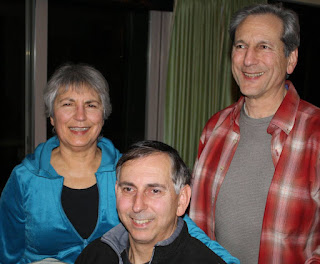
Linda, Roger and Paul Spadoni
“He must have had some engineering background,” Roger said. “The way I heard the story is that before the stock market crash and the depression, he had put together a syndicate of investors to develop the property into a resort. He had some equipment accumulated out there, some pumps and other metal parts for the engineering setup. Then the financial crash hit, and his investors all went bankrupt, and the plan fell apart. That’s pretty much what ruined his life. He was stuck out here with the property. He had given up his employment to start the development. And then when everything crashed, there was no employment to be had, so there was no place for him to go back to work. I have no idea what he lived on while he was up here, because there was no social security for him to live on (Social Security did not start until 1935, during the Roosevelt administration). Possibly he had some kind of pension. He certainly didn’t grow enough goats to live on.”

As our research shows, though, Sohrweide was neither an engineer nor an inventor, and he seemingly had a fairly normal life for at least his first 30 years. Then he became a bit of a drifter for the next 25 years, though he still lived in mainstream society, before he finally ended up in Rosedale—where he became a little more estranged from society each year. He spent his last seven years in a Tacoma nursing home.

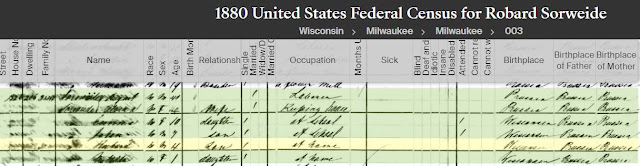
Reinhard August William Sohrweide was born December 31, 1875, to August Ferdinand Friedrich Sohrweide and Alwine “Alvina” Louise Friederike Auguste Maass in 1868 in Milwaukee, Wisconsin. His parents were both born in Prussia, Germany, and immigrated to the United States in 1865 and 1867, respectively. The name Sohrweide comes from two German words: Sohr, meaning dry or withered, and weide, meadow or grassland. The census shows that other Sohrweide families already lived in Milwaukee, no doubt relatives, who would have helped August and Alvina get settled.

This shows Reinhard as 4 years old in the Milwaukee federal census of 1880, though the person who placed it in the index interpreted his difficult-to-read name as Robard.

Raynard 
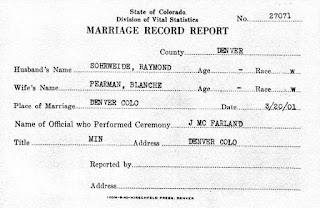
Raynard went by the name Reinhard until his mid-twenties, when he decided to use a more American-sounding name. He often just used his initials, R.A. He had two sisters, Emma (1870) and Martha (1879). His brother Johann, three years older, legally changed his name to John in 1902. August, Johann and Reinhard are all listed at the same address in Milwaukee in 1893. August is listed as a laborer, Reinhard as a carpenter and Johann as upholster. In 1896, the directory is the same, except Reinhard is now an upholster like his brother. The next year, Reinhard and Johann moved to Denver, Colorado, and in the 1898 Denver directory, they are sharing a room and working as upholsterers for E.C. Hartshorn. The next two years, the brothers have separate addresses but are still working for Hartshorn, and on March 20, 1901, Raymond Sohrweide married Amy Blanche Pearman. In January of 1902, Blanche (she went by her middle name) gave birth to Dorothy Mary, and in 1904 to Leroy Ambrose.

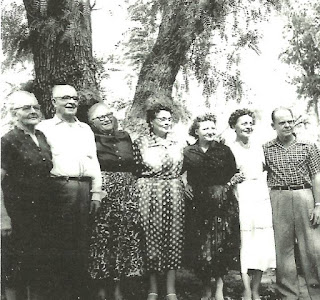
Sohrweide's wife Blanche is shown on the
far left in this family taken late in her
life with some of her brothers and sisters.
Both brothers continued to work as upholsters, but in 1902, their employer was listed as the Pullman Company. By 1903, John had moved away from Denver, but Raynard continued to work for the Pullman Company through 1906, the year his father died. Shortly after that, Raynard and Amy’s seemingly normal life as a couple came to an acrimonious end. They were granted a divorce January 18, 1908. Amy took the children; Raynard left Colorado when Leroy was in grade school and they never saw each other again. Dorothy came to Gig Harbor when Raynard had to be moved to a nursing home in Tacoma. Blanche remarried in 1913 to John Fielden Oliver, and the couple gave birth to John Monroe Oliver in 1920.

Where Raynard lived from 1908 to 1916 is not known, but in 1916, he shows up in the Seattle city directory as an upholsterer, working for the “SM&U Co.,” which is the Seattle Mattress and Upholstery Company, founded in 1882 and existing today as Seattle Mattress.

Among other things, SM&U made custom mattresses for boats, and it could have been this connection that led Raynard to future work in the fishing industry during his years in Seattle. On his 1918 draft card, he is working for the Puget Sound Bridge and Dredging Company, and in the 1919 Seattle directory, his occupation has changed to shipworker. Sometime in the 1920s, he purchased a used fishing vessel—probably a gillnetter, since the records say it had a crew of one—and lived on it. This can be surmised because on his boat registration papers for 1928 and 1931, his address is written as “care (of) 5016 W. Marginal Way,” which was the home of Edward Wislocker, a ship’s carpenter. This was also Sohrweide’s address in the 1927 Seattle directory, which again listed him as an upholster. He also spent some time in Tacoma and can be found in the 1924 Tacoma directory working as an upholsterer for the Washington Parlor Furniture Company, Inc.

When he purchased the Rosedale property in 1929, he was still living on his boat, and most likely, he piloted the boat to Rosedale and continued to live in his boat until his cabin was habitable. It’s not clear when he moved on shore. He is not listed in the 1930 Rosedale census. Dick Meyer Sr., who was born in 1931 and grew up his family’s farm, recalls seeing Sohrweide’s boat in the Rosedale lagoon.

It’s also not known whether Sohrweide built his shack or instead refurbished whatever was left over from the days when Joseph Oakes homesteaded the land. It is quite likely that any fruit trees on the land were holdovers from Oakes, as Greg Spadoni’s research showed that Oakes planted 240 fruit trees from 1884 to his death in 1890.

“It looks to me like Sohrweide might have been living in the original homesteader’s house, although it could’ve been the second house on the land,” Greg said. “If the original house still existed, it had to have been pretty dilapidated when Sohrweide bought it, because Dick Meyer told me that Sohrweide lived on a broken-down fishing boat in the lagoon until it rotted out from under him. You’d think he would’ve lived in the house if it was in decent condition, but that’s probably something else we’ll never know.”

Sohrweide is listed in the 1940 census, which also has a column that asks whether the person lived in the same place in 1935, and he was there then as well. The census also states that he had attended school through the 8th grade and his house was valued at $500.

Though he lived alone, his reclusive and suspicious nature probably did not manifest itself in his early years in Rosedale, as many of us who were children in the 1950s recall that our parents and grandparents were on friendly terms with him. Maize recalls that Raynard’s brother sometimes came to visit. And while many who knew him in his later years described him as paranoid, some of that can be attributed to the fact that people have told tales of sneaking around Sohrweide’s house when they were kids, hoping to see him without being detected. As the character Harold Finch in the 2015 movie Asylum said: “It’s not paranoia if they’re really out to get you.”

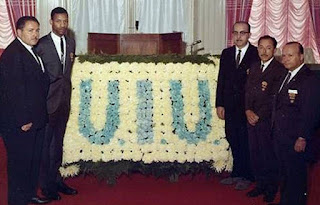
Members of the Upholsters International Union
The knowledge that he had worked as an upholster as early as 1896 probably explains his income during his years in Rosedale. The Upholsters  International Union of North America was founded in 1892, and as of 1936, it was estimated that they had 11,500 members—and they had a pension fund. It is common knowledge that Sohrweide went to Gig Harbor on a regular basis—probably monthly—to cash his checks and do his shopping.

Continue to chapter 5


Tuesday, January 11, 2022

Descriptions of Sohrweide vary, but a few details stand out, including odor

Chapter 3, The Old Goat Man of Rosedale

Sohrweide’s actions in chaining up his truck were not the only example of his growing paranoia. Joel Anderson, brother of Joan Anderson Adler, said he recalled Sohrweide expounding on various conspiracy theories and saying he was afraid that the Freemasons were out to get him. When Sohrweide’s shack caught on fire in 1961, he first blamed it on my uncle, Ed Elford, who was the one who discovered the fire.

“Ed was the one who saw the smoke and went over and saw Mr. Sohrweide working outside,” Linda said. “Ed ran to tell him, and he thought Ed had done it. Sohrweide said, ‘Why did you put my house on fire? Why are you burning my house down? What have you got against me?’ ”

Ed Elford
Apparently, Ed successfully pleaded his innocence. The neighborhood consensus was that some firewood or other flammable material had been placed too close to the woodstove. However, Steve Spadoni, son of Al and Gloria, recalls going to look at the burned ruins after he came home from school and hearing Sohrweide now blaming the fire on an unidentified group of enemies.

“I remember being at his place after it burned down with some of the adults from the hill,” Steve said. “I don’t really remember who all was there, but I remember Sohrweide saying, ‘The gang did it, the gang burned it down.” He didn’t say anything about kids or anything like that, and I don’t really know what he meant. But I definitely remember him saying that.”

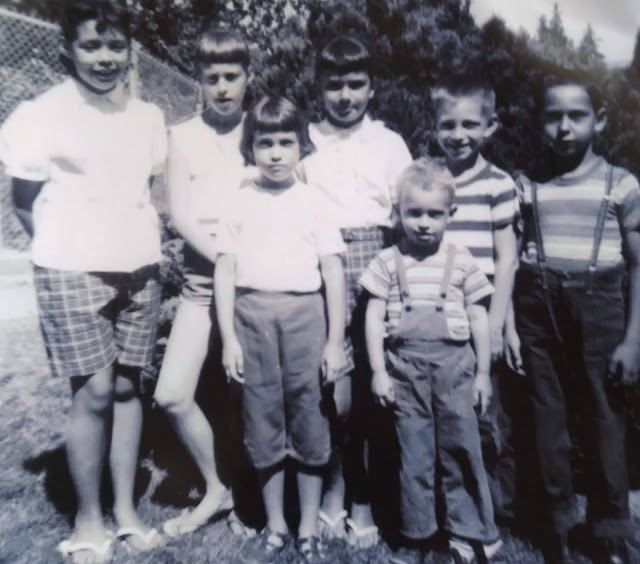
Here are some of the neighborhood children who grew up on Spadoni Hill and had the privilege of seeing the old goat man Mr. Sohrweide. Top: Maize (Patty) Elford,  Ginny Spadoni, Darlene Elford, Steve Spadoni, Paul Spadoni. Front: Teresa Spadoni, Greg Spadoni.

Fire fighters were hindered from their duties because the road from Spadoni Hill to the cabin had grown over with vegetation and was only a narrow trail.

“Dad had one of the bulldozers at home, and he poked a road in so the fire trucks could come in to put out the fire,” Linda said. “And Mr. Sohrweide was very angry about that, too. Now there was a road right to his property, and anybody could drive in there.”

Presumably, Sohrweide developed a more favorable view of Dad when he and uncle Roy used their sawmill to cut the lumber needed for a new shack, and then Dad, Roy, Grampy and perhaps uncle Claude Spadoni built Sohrweide a new home.

“The neighborhood got together and got lumber and built him a new shack,” Linda said. “And Grandma gave him a broom, and he looked at it and said, ‘Well, the last one lasted me 50 years. This one will probably outlast me.’ So you know he probably didn’t do too much housekeeping.”

Jim Langhelm recalls another example of the goat man’s eccentric nature. Prior to Sohrweide’s purchase of the property, Pierce County had obtained a 60-foot right-of-way to build a road, Ray Nash Drive, along the waterfront, cutting through the western portion of Sohrweide’s parcel.

“One time the power company was going to replace some poles on Ray Nash,” Jim said. “They were on Sohrweide’s side of the road, and they put in some new poles, but Sohrweide was unhappy about it and cut them down with his axe before the power lines could be installed. I remember seeing the cut poles lying against the hillside.”

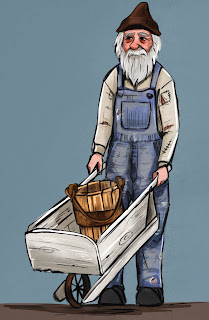
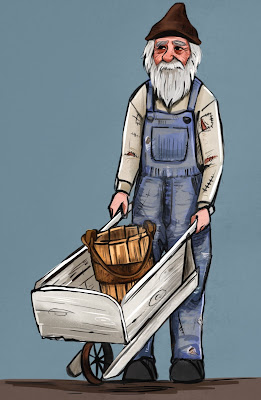
Unfortunately, no one I spoke with had any photos of Sohrweide, and trying to get a description of him led to some fairly vague and sometimes contradictory statements. It may be best if I just provide some quotations and save my own comments to the end.

Marjorie Spadoni: “One day he came over, knocked on the door and said hi. He said, ‘Could I have a little water?’ He was unkempt, with white bushy hair. I can’t remember if he had a beard. He was about my height (5-4). He didn’t look malnourished. Maybe he ate a goat once in a while.”

Carol Spadoni Parker: “He was not very tall. He wore a funny hat, but I don’t remember what the hat looked like.”

Gary Michaels: “He dressed in ragged clothing and was bearded with straggly hair.”

Maize Elford: “He had a long white beard.”

Steve Spadoni: “He seemed so big, but we were just little kids. It seemed to me like he was wearing an old rawhide jacket or something and a goofy old hat.”

Rosemary Land Ross: He had a beard, as I remember. His standard mode of dress, like so many people in that era, was overalls. I never saw him in anything but overalls. I can’t say that I remember him wearing a hat.”

Joel Anderson: “I don’t think he had a beard. My picture of him is that he had kind of reddish or tan skin, and he wore a hat.”

Sohrweide’s 1918 draft card lists him as of medium height and medium build, with blue eyes and brown hair.

Probably one of the best descriptions came from Joan Anderson Adler, who was older than any of us who grew up on Spadoni Hill: “He’d appear sometimes at the Rosedale church, after the service, and he’d be without a shirt. He had on a one-piece underwear, and he didn’t cover the top. His undershirt was so gray and dark. He never washed it, apparently. It was a single piece underwear kind of thing, but he had pants on over the bottom part. He smelled like his goats. He didn’t go to the church service. He’d appear afterwards, maybe when he wanted to see mother, or maybe when he knew he’d need a ride to Gig Harbor.

“I remember his shirt so well, but I don’t remember his face, except that his hair was gray and messy. I don’t picture him with a beard. I’m 5-6. He was taller than me. I was that height by age 12. He probably was medium, but not unusually tall. I don’t remember him being stooped, just that he smelled. He smelled like his goats. I kind of think that maybe he slept with them in the house or something, but we didn’t know.”

Banashree Das art
Sohrweide’s odor seemed to be one remembrance that stood out to most people. That, and the fact that his goats were free-roaming and often went into other people’s yards, led to him being referred to as the goat man—even long after his goats were all gone.

After listening to all the descriptions, relying on my own memories, and making some executive decisions, I compiled a composite description and sent the information to an artist friend. She came up with the drawing that I’m including on this page. It shows Sohrweide as I remember him, coming to get water from Grampy’s well with a bucket and an old wheelbarrow.

Beverly and Sohrweide's kid
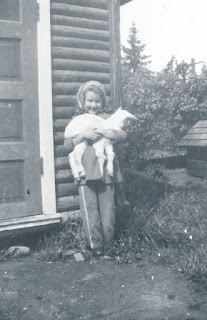
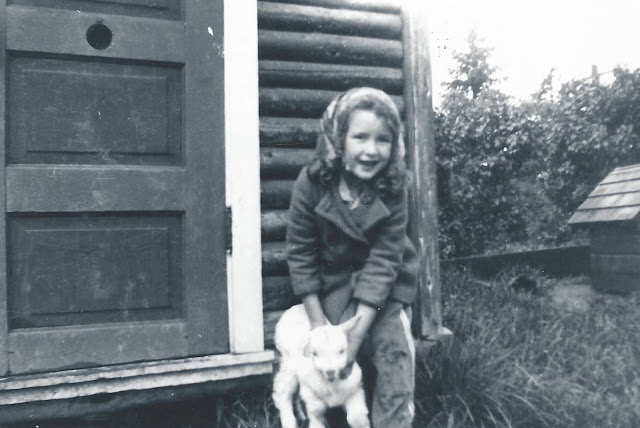
While no pictures of Sohrweide exist, I was able to run down a photo of one of his goats, being held by Beverly Abel Jackson. “I grew up in the house across from the Rosedale church, and I have a picture of me holding one of the baby goats that had escaped from the goat man,” she said. “They got out occasionally and went to the cemetery to eat flowers. One wandered down to our place. I was maybe 5 or 6 years old, and I held the goat while somebody took a picture. I really wanted to keep it. Most of what I knew about Mr. Sohrweide is that we didn’t know much. We were told never to go up on his property because he had bear traps, and we might step on one and be caught there.”


While Beverly may have appreciated the chance to play with a baby goat, other people did not appreciate having their gardens trampled and eaten. Since Sohrweide had no telephone, people had little recourse other than chasing the goats away repeatedly. Or shooting them.

“My uncle Bob (Langhelm) told me that Bob Abel (the brother of Beverly) shot one of the goats,” Jim Langhelm said. “He didn’t relate many details about the incident, nor did he say why it was done, but the goats were known to roam the area and pester the neighborhood, and it’s possible that it was done in an effort to trim the herd.”

Beverly said she never heard that story and questions whether it is true. “My brother wasn’t mean,” she said, “but he did have a gun and he used to hunt for the family.”

The goats were obviously a menace to more than one neighborhood garden, and Dick Meyer Sr., father of Kevin and Dick Jr., found a creative way to express his displeasure, in this story told by Greg Spadoni.

“In late summer 2005, I was at Mom and Dad’s,” Greg said. “I asked Dad what he remembered about Sohrweide. He said that one time someone had hung one of Sohrweide’s goats on a fencepost. Sohrweide was so angry that he was roaming the neighborhood with a rifle, vowing to find and shoot whoever was responsible. Julius got wind of it and went to talk to Sohrweide and took his rifle away from him.

Dick Meyer Sr.
“On my way home, I stopped at the Meyer farm and asked Dick Meyer (now deceased) what he could remember about Sohrweide. Dick had grown up on the farm, so he had known Sohrweide for many years. He got a twinkle in his eye and a half grin on his face and replied, ‘Well, I’ll never forget that time I hung one of his goats on a fence post.’ Sohrweide always let his goats roam free, and they would all too often raid the crops at the Meyer farm, so they were a big problem. Just to set the record straight, Dick didn’t kill the goat, or even injure it. He simply immobilized it.”

Greg Spadoni
In case anyone thinks that hanging a goat on a post might be cruel and unusual punishment, Greg added the following tale: “I know from personal experience, goats have incredibly strong necks. I was making a crushed rock delivery in Crescent Valley and had to drive uphill on a long, one-lane community road to reach the end, where I was going to start the spread. Going in, pulling a full load uphill in a low gear, I had to keep the engine wound up tight. I noticed at a house ahead on the right a full-grown goat tied by a leash to an overhead dog run cable about fifty feet long. When I got close, he ran full speed from one end of the run to the other and never slowed down when he reached the end. He was jerked violently off his feet by the leash on the collar around his neck, and I thought he’d broken his neck. But he immediately got up and ran full speed to the other end, coming to an equally violent stop. When I got to the top of the hill and talked to the neighbor about it, he told me the goat did that all the time, just for fun. So it wasn’t the noise of the truck. He was just living his normal life.”

In any event, the goats were all gone by the early 1950s, and for a time, Sohrweide replaced them with dogs.

Jim Langhelm Jr
“The dogs stayed closer to home than the goats,” Jim Langhelm said. “but they terrorized us kids on bicycles that passed by his place along Ray Nash Drive. We as kids played with kids that lived near the Island View Market on Ray Nash, and we always feared running the gauntlet in front of Sohrweide’s because we never knew when the dogs would chase us on our bikes. We also never knew where they were going to come from, because they would ambush us from above the road or come up off the beach, because Ray Nash at that time bordered the beach. As a result, we would load our pockets with rocks to throw at them to fend them off. Looking back at it now, I don’t think they were vicious because they never made physical contact with us. I think they just enjoyed the thrill of the chase.”

One thing many people today remember is that their parents would give Sohrweide rides to Gig Harbor.

 “He’d walk all the way to Gig Harbor with a gunny sack to go shopping,” Linda said, “and you’d see him walking up the road. Grampy said he’d go there when his pension check was due. He’d get his check and cash it, and then go buy groceries and walk back.”

“My dad used to give him rides to the store when Dad saw him walking,” Dave Langhelm said, “and Dad’s car would then stink of goats for a while.”

Greg said his dad, Al Spadoni, “would never give Sohrweide a ride in the car because he smelled so bad, but he would in his old pickup because it had no side windows, so it had maximum ventilation.” Vivian remembers that Al sometimes avoided the problem of Sohrweide’s peculiar odor by giving him rides in the truck bed. But perhaps the truck bed was already full during one incident, related by Greg.

“One time I went with Dad to Gig Harbor in the old 1933 Chevrolet pickup,” Greg said. “I don’t know if it was the time we went to Austin and Erickson’s lumber yard, but we did end up in the parking lot in front of the Thriftway store, where the post office is today. Sohrweide came out of the store with either one or two big bags of groceries, and Dad pulled up next to him and offered to drive him home. He accepted, put the groceries in the back and climbed in the cab with us. There was room for only two adults in that little truck, so I was wedged between the two of them. I don't know if I’m remembering or imagining that I smelled an odor of dirty, musty clothes. So many people have said that he stunk, it might just be the power of suggestion that makes me think I smelled something. I also recall Sohrweide bringing fruit to our house in a wheelbarrow. I wonder if that was in return for the occasional car ride.”

Continue to chapter 4

Sunday, January 9, 2022

The Goat Man, relatively friendly at first, grew more suspicious as he aged

Margaret and Julius Spadoni
Chapter 2

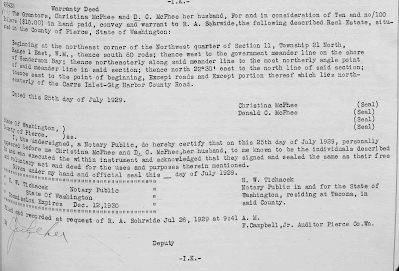
My parents, Julius and Margaret Spadoni, bought 100 acres in 1946 from Blanche Grant, whose father Joseph Oakes had homesteaded the land in the latter half of the 1800s. The west side of this 100-acre Rosedale parcel, overlooking Henderson Bay and the Olympic Mountains, later came to be known by locals as Spadoni Hill, so-named not just because of my parents’ ownership and residence there, but also because they sold parcels to four of my dad’s relatives and to my mom’s parents, all of whom built there in the 1950s. The Oakes homestead also included another large parcel to the north, about 50 acres, which records show was purchased by “R.A. Sohrwide” July 25, 1929, from Christina and Donald McPhee. The land had changed hands four times since Oakes died in 1890, but none of the subsequent owners had lived on it. The fascinating account of homesteader Joseph Oakes and his heirs is told in a well researched story by Greg Spadoni that can be accessed by clicking here.


Reading about Oakes and the early history of the property prompted me to do some research about the equally interesting story of Raynard (sometimes spelled Reynard or Reinhard) Sohrweide. I was introduced to Sohrweide by John Wagoner, my grandfather on Mom’s side, and one of Sohrweide’s few friends in his days in Rosedale.

John and Jeannette Wagoner were the first to build on Spadoni Hill, living in a small wooden cabin they built in the late 1940s, on the parcel now occupied by Dennis and Sherrie Peters. While living in the cabin, John and Jean dug a well and built a concrete block house that they lived in while they built a still larger orange brick home. The cabin is long gone, but the other two buildings still stand. Dennis and Sherrie use the concrete block building as a garage, and they live in the brick home, although they have since added a second story.

Dad, Mom and my sister Linda and brother Roger then lived in the Wagoner’s block house while dad built another house next door, now occupied by Paul and Becky Floyd. I was born in 1953, the year our family moved into the partially completed new house. Linda and Roger remember sleeping out in the original one-room cabin on occasion, but it was torn down in the early 1950s, and it’s only a foggy memory to me.

Shortly after the Wagoners and my parents built on the hill, other relatives joined them: Ed and Lola (Dad’s sister) Elford, Al and Gloria Spadoni, and Roland and Marjorie Spadoni—whose house at the end of the road was closest to Sohrweide’s. In the late 1960s, Roy and Marie Anderson—at one time the only non-relatives on the hill—built a house between the Elfords and Roland and Marjorie in the 1960s. After Sohrweide’s death, two other relatives built houses pretty much where the goat man’s house had been.

Sohrweide and Grampy, as we kids called grandfather Wagoner, got along quite well and visited regularly. I remember going with Grampy at least once to visit Sohrweide in his one-room cabin, but being very young, the significance of the meeting was lost on me. I remember almost nothing, except an image of a patchwork shingle roof, Sohrweide’s old woodstove and the smell of wood smoke.

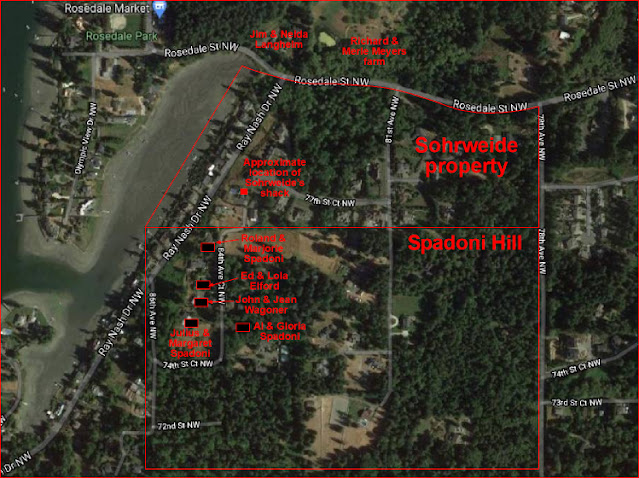
While the aerial photo is current and is taken from Google Maps, the boundaries and homes
shown were as they existed in the 1950s, when Ray Nash Drive NW was located right
along the waterfront. Both properties were otherwise unoccupied by homes.


My cousin Greg, son of Al and Gloria also remembers Grampy taking him to visit Sohrweide. The visit made a lasting impression.

“I couldn’t have been more than five,” he said. “Mr. Wagoner apparently thought it would do us little kids good to see him check up on an invalid. Whether it was to introduce us to the cycle of life or to see how important it was to check on the welfare of neighbors, I don’t know. Maybe both. Maybe something more. In any case, I never forgot it.”

For some reason, people on the hill always pronounced his name shore-widey instead of sore-widey. Maize said she actually thought his name was pronounced shore-whitey. However, other people in Rosedale who knew him pronounced his name correctly.

Sohrweide did have other friends, including Peter Land and Borghild Jensen Anderson. Kevin Meyer, brother of Dick, said that his grandmother Anna Meyer would sometimes bring meals to Sohrweide. Borghild’s son Joel said Sohrweide would occasionally drop by his house to visit with his mom. Nonetheless, the goat man became progressively reclusive as he aged. Land died in 1957 and Wagoner in 1962, so when Sohrweide died in 1969, his small circle of friends had dwindled. While I’m sure that Land, Wagoner and Anderson probably knew quite a bit about Sohrweide’s background—and probably my parents did as well—much of his life was a mystery to those of us who grew up around him from the 1950s onward. We didn’t know when he moved there. To us, he had always been there.

“I didn’t know that the property had been homesteaded before,” Linda said. “I just thought Sohrweide had lived there forever. You know how it with little kids. It is how it is, and that’s how it must have been.”

Carol Spadoni Parker, daughter of Roland and Marjorie and Linda’s childhood best friend, said, “He may have homesteaded the property. I’m pretty sure he once had a regular job. I think my dad knew what he had done for a living, but I don’t know.”

Joan Anderson Adler, one of Borghild’s daughters, said she thought Sohrweide probably homesteaded the land. She also had some interesting but ultimately inaccurate theories about his earlier years. “I believe his wife came with him, but she died very early on. Apparently, he became a recluse after his wife and child died. As I recall, it was probably in childbirth, and from then on, he just closed up on himself and the world.”

One of Joan’s childhood friends, Rosemary Land Ross, recalls the common bond that Sohrweide and her father shared: “My father Peter Land and Mr. Sohrweide were very good friends and would get together because they shared a common heritage; they were both from Germany. As a child I can remember going with friends, and we would see how close we could get without him finding out that we were trying to sneak up on the little encampment that he had. He would never lift a hand to hurt anybody. He was perfectly harmless. I quite often had to do my best to avoid his goats because I walked past them every morning on my way to school.”

“He was definitely a part of our childhood, in a strange way,” Joan said. “There was a fascination. I’d walk down to Rosemary’s house, and we’d look up the hill and wonder if we’d see him. We never saw him while walking by, but we were always aware that he lived up there.

“He was just such a character, kind of exotic to those of us growing up in a small place like Rosedale. It was just part of the color of the community, one of the fun and odd parts of childhood. It was fascinating because we didn’t really know him. We’d just see him once in a blue moon. He certainly wasn’t a mixer.”

Those of us living on Spadoni Hill during the earlier years probably saw him most often, mainly because of his friendship with Grampy.

“In the summers, his well would go dry, and he’d come with a couple of buckets to get water,” Linda said. “He spent a lot of time making trails through the woods and lining them with rocks along the side. I don’t remember him ever having a house, just a little shack under a big maple tree.

“Carol and I would make cookies sometimes, and we’d put them at the edge of the trail with a note that they were for him. And then he’d leave the empty pans with a note that said thank you. But we never knew if he actually ate them or not.”

Borghild Anderson would also leave packages for Sohrweide in his mailbox, said Joan. “Mother was somebody who loved people, and she would leave him things she had baked. And then he would write her a beautiful, educated letter back, using strange paper that was not stationery. It might have been the back of a light-colored paperback. His handwriting and his language was beautiful. It was always interesting to us.”

While Sohrweide enjoyed Grampy’s company and trusted him, he initially did not have much love for the other occupants of Spadoni Hill. He seemed to feel that we were intruding in his world, perhaps because our houses were close to his.

“He once said that John Wagoner was a good man, but it’s too bad he’s associated with those Spadoni commune-ists,” Roger said, explaining that because all the families on the hill were related and worked closely together, it was tantamount to living communally.

“One time when Dad and Roy were selling some logs,” Linda said, “they went to Mr. Sohrweide and asked if he wanted to sell some trees to get some money. He said no way. He thought it was a plot to get his land; the Spadonis wanted to steal his trees, and he said absolutely not.”

Sohrweide instead hired Bill H. Sehmel, his son Charlie and Lyle Severtson to do the logging in the late 1940s. Shortly after that, Sohrweide obtained a truck, which lasted only a few years. The truck was either made in the 1930s or 1940s, depending on who is doing the remembering, and it was in running condition up until the early 1950s.

“When I first moved up here,” Linda said, “he had a rickety old truck. He’d just let his goat wander, and they’d go all over the area. And somebody would get him a message that his goats were in their garden, and that if you don’t come to get them we’ll shoot them. Sometimes he’d go get them in that rickety old truck. One time I saw him coming back with a dead goat tied to the front. A person had shot it.”

The truck is another part of the intrigue of Sohrweide’s legacy, and it reveals another aspect of his evolving personality—borderline or outright paranoia.

“He felt people were out to get him,” Linda said. “Everything bad that happened was somebody’s bad plan, that they were out to get him. Every time he got sick, he thought that it was because somebody put poison in his well to get his land or steal his truck.” The truck is a good example of his paranoia.

 “When his truck quit running, some teenage boy from around here told him he could fix his truck for him,” Linda said. “Then the old goat man figured that now somebody could steal his truck, so he put sand in the gas tank and chained it to a tree. That was what I heard. And if you went and looked, it was chained to a tree. I never looked in the gas tank.”

Jim Langhelm provided more information on the truck incident: “Someone talked Sohrweide into letting them do some logging on the property, and as partial payment they gave Sohrweide an old truck, which soon broke down. Gary Michaels offered to fix it, but then Sohrweide changed his mind.”

How true is the story about the truck? Charlie Sehmel does not remember anything about giving Sohrweide a truck. It is possible that Sohrweide bought the truck with proceeds from the timber instead. It also seems likely that the loggers put in a road leading through the Spadoni Hill property. The road soon grew over and became only a trail once Sohrweide stopped driving the truck.

“I don’t recall ever seeing him driving the truck on the county roads,” Jim Langhelm said. “I had it in my mind that he didn’t know how to drive it. I also don’t recall any of the few ‘logging roads’ that were put on his property ever exiting out on to any of the county roads. I think his only road access was off the end of your road on the hill at Roland’s house.”

Roger, however, does recall a road from Sohrweide’s land that accessed Rosedale street, and it was likely that at least during the times the loggers were active, there were two ways to enter the property: off Rosedale Street and through Spadoni Hill onto what is now called 84th Avenue Court NW.

I was able to track down Gary Michaels to get his version: “Mr. Sohrweide was a paranoid recluse and a bigtime hoarder. He had a lot of junk around his house, and if you looked in the front door there was stuff stacked to the ceiling with a narrow walkway through his living space. Carl Jacobson and I tried to befriend him in our high school days (1956-57). We had our own junk business collecting scrap metal, old cars and anything else of value, selling what we could find to old Joe Sussman at his scrap business in Tacoma. Since we were looking for scrap, the goat man was a logical fellow to cultivate. We did convince him to let us try and get his late 40s Chevrolet pickup running but were unsuccessful. As a last resort, we attempted to start it by rolling it downhill. Failing to get it started was the last straw. By then, the goat man was sure we were trying to steal his truck, so he chained it to a tree. That was the end of our relationship with the goat man.”

What became of that Chevrolet truck is unknown. However, he also had an older truck, which my brother Roger believes was a Model A or T Ford. Roger remembers both trucks, and he and cousin Alan Spadoni (the late son of Roland and Marjorie and brother of Carol) actually spent time playing on the old Ford. Roger and Alan, it seems, were only young people on Spadoni Hill who were not afraid to go on Sohrweide’s land.

“We asked him if we could play on it, and he said yes,” Roger said. “At that time, I was probably 12 or 13, and it wasn’t in a condition to be repaired. It was probably salvageable for parts.” Roger was born in 1947, so this would have been around 1960, perhaps four years after Gary Michaels and Carl Jacobson tried to get the newer truck running.

“He didn’t seem unfriendly to me,” Roger said of Sohrweide. “Maybe a little suspicious the first time we knocked. He said that other kids would sometimes knock on his door and then run away.”

In any event, to Roger and Alan’s disappointment, the old Ford disappeared shortly after Sohrweide went to a nursing home in the early 1960s. “Less than two weeks after he went to the nursing home, somebody came in with a bulldozer and towed his truck out of there,” Roger said. “Alan and I kind of had our eyes on it. We followed the tracks right out to Rosedale Street.”

Roger speculated that maybe one of the loggers who purchased and harvested trees on the land had also coveted the relic. However, it seems more likely that Sohrweide needed money to pay for his health needs, and either he or a family member or friend arranged a sale. It’s probable that the Chevrolet truck was hauled away at the same time. 

Continue to chapter 3


Friday, January 7, 2022

The story of our mysterious childhood neighbor, the recluse of Rosedale

Introduction
Giovanni Boccaccio’s “The Decameron” is a classic work of Italian literature written during times of the Black Plague in Italy. Seven young women and three men moved to the country to isolate themselves and avoid becoming infected, and during their self-imposed exile, each person had to tell the others a story a day for 10 days, and thus the book tells 100 different stories.

Because of COVID-19, I have only been able to travel to Italy once in 2020 and 2021, and like Boccaccio, I have used some of my time to reflect and write. The result is a story that is unrelated to my time spent in Italy but is, rather, a reflection on a childhood experience. I had the privilege to grow up in the Rosedale neighborhood of Gig Harbor next to a man who is now largely forgotten, but during my youth, he was the stuff of legends, a man of mystery who inspired many stories. Some stories were actually true, but others were the fantastical products of half-truths and the vivid imaginations of his neighbors.

What follows is the result of my investigations into our childhood neighbor, Mr. Raynard Sohrweide.

***

The Old Goat Man of Rosedale

By Paul Spadoni

Copyright January, 2022

Chapter 1

A fine line separates the weary recluse from the fearful hermit. Finer still is the line between hermit and bitter misanthrope. Dean Koontz


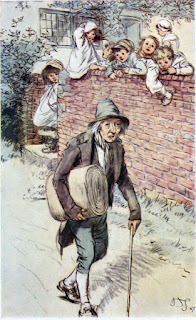
Silas Marner, as drawn
by Hugh Thomson
Silas Marner is the tale of an outsider recluse in England who was regarded with curiosity and suspicion by his neighbors. I read this novel by George Eliot during high school. Having grown up in a rural Gig Harbor Peninsula neighborhood next to a similar man, I didn’t appreciate how rare it was to encounter a true hermit.

We called him Mr. Shorewidey, or “the old goat man,” though by the time I was old enough to meet him, his goats were gone, replaced for a time by dogs. I have little to no recollection of the dogs, either; they didn’t last long. Mr. Sohrweide—his true last name—spent his final years next to Spadoni Hill in Rosedale living in nearly utter seclusion.

To me and the many cousins who grew up as my neighbors, Sohrweide was a man of mystery. I encountered him only a few times. Some of my neighbors and cousins can’t even recall meeting him, yet he somehow made a deep impression.

Dick Meyer Jr, with whom I grew up playing youth league and high school baseball, lived on a farm just north of Sohrweide.

“He was a legend of mythic proportions in our house,” Dick said of Sohrweide. “I have no memory of actually meeting him. But I do remember always running anytime we passed the trail that led to his house in the event he would see us and take us up the hill, and we would never be seen or heard from again. My dad really enjoyed playing on our imaginations.”

My sister Linda, eight years older than I, remembers Sohrweide and his goats. One of the goats head-butted her to the ground, resulting in a childhood fear of goats—though as an adult Linda farmed goats herself, so the fear was not permanent.

“He wasn’t friendly to us,” she said. “We were all scared of him because the reputation was that if you came on his property, he would shoot you with a shotgun. But we never went over there. We’d dare each other to go further down the trail and further down the trail, but if we heard a noise, we’d run back. We didn’t know if he’d actually shoot people with a shotgun.”

Cousin Dave Langhelm grew up on property at the head of the Rosedale lagoon that shared a border with Sohrweide on the south. The family moved there in 1949. “As a kid, I was terrified of him,” Dave said. “I can’t remember meeting him, but we used to play around in the woods near his property, and sometimes we went on it. It stunk highly of goats around his house. We considered it a great feat to go on his land without being caught and yelled at.”

The story of sneaking around the edges of Sohrweide’s property was repeated by several childhood friends and neighbors.

“I never talked to Mr. Sohrweide, but he was source of great excitement,” said Darlene Elford Kiefer, who grew up on Spadoni Hill. “We never saw him, but we used to sneak as close to his cabin as we could and watch for him. We believed that he had a rifle and would shoot us. I remember one time looking around his cabin, but the only thing that stuck in my mind is that he had little packets that you added to butter to make it yellow.”

Darlene’s sister Maize (known as Patty when younger) Elford recalls being unafraid of Sohrweide, but she agrees that he was enigmatic. “Mr. Sohrweide was a mysterious character to us,” she said. “We were fascinated by him and wanted to know more about him. Now and then we would see him walking down the road past our homes. His persona was gentle; he was not threatening.”

Jim Langhelm, Dave’s older brother, said, “We kids were scared of him and never went on his land, and I don’t remember ever talking to him. My only contact with him was on the occasion that I was in the car when dad gave him a ride when he came upon him walking on the road. I also remembered that he ‘witched’ the spot in the back yard where dad and I dug the well we used for several years. I was around 10 when we dug it.”

How did Sohrweide come to live on his wooded 50 acres? What was he like? What was his source of income? His past? Did he have family somewhere? What drove him into seclusion?

For Silas Marner, the betrayal of his business partner, who stole Marner’s fiancé and framed Marner for embezzlement, drove him into seclusion. He worked alone on the edge of a rock pit, weaving cloth for sustenance.

The questionable sound of Silas’s loom, so unlike the natural cheerful trotting of the winnowing-machine, or the simpler rhythm of the flail, had a half-fearful fascination for the Raveloe boys, who would often leave off their nutting or birds’-nesting to peep in at the window of the stone cottage, counterbalancing a certain awe at the mysterious action of the loom, by a pleasant sense of scornful superiority, drawn from the mockery of its alternating noises, along with the bent, tread-mill attitude of the weaver. But sometimes it happened that Marner, pausing to adjust an irregularity in his thread, became aware of the small scoundrels, and, though chary of his time, he liked their intrusion so ill that he would descend from his loom, and, opening the door, would fix on them a gaze that was always enough to make them take to their legs in terror. Nobody in this world but himself knew that he was the same Silas Marner who had once loved his fellow with tender love, and trusted in an unseen goodness. Even to himself that past experience had become dim.

Silas Marner eventually rejoined society, but Sohrweide, who apparently had a fairly normal childhood and young adulthood, gradually became more reclusive as the years went by. None of those of us living now who grew up next to Sohrweide really knew much about his past. We can recall bits and pieces of stories told here and there. Some of what we believe is accurate, but much is not, as I have discovered.

Continue to chapter 2


Sunday, January 2, 2022

More Seghieri families in the world

Through a combination of the marvels of the internet along with painstaking research in ancient documents, I’ve recently found the connection to another branch of the Seghieri family in France. And just days later, I made a connection to a separate Seghieri line in Argentina.

The French family joined one of the two Seghieri family Facebook pages, and from there made friends with other French relatives. Florian Seghieri and Georges Seghieri, members of this previously undiscovered line, are now considering attending the family reunion in Montecarlo in May.

However, the new family did not know exactly how they were connected to the family tree. This is where the old-fashioned research comes in, and the credit for that belongs to family friend Sergio Nelli. Doctor Nelli is a famous Montecarlo historian and author who has spent countless days poring through civil and church records and compiling information on the founding families of Montecarlo.

Doctor Nelli has kindly shared some of his research on the Seghieri family with me, which I have compiled into a huge family tree kept in a computer database. Using his information, it was a simple matter to find the ancestor who moved from Italy to France in the mid-1800s. Adamo Emilio Seghieri, born in Montecarlo in 1851, largely disappeared from my database—and next appears in French records when he married Thérèse Pacouill in 1878 in Millas. Later that year, Thérèse gave birth to Antoine Seghieri, the great grandfather of Florian.

The Argentine Seghieri family connection came about when Graciela Seghieri asked on the Seghieri / Seghieri Facebook page if anyone had information about Nello Seghieri and his brother Armando. I had both of these men in the family tree, born in Montecarlo around 1900, but I had no information about them after that time. As it turns out, this is because both of them emigrated to Argentina. Armando had returned to Italy for some visits, Graciela said, but Nello never did. Nello had four children, three of whom are now deceased, and Graciela is his granddaughter. Ancestry.com shows that Graciela’s late father Humberto was my fourth cousin. I have been using Google translate to write to Graciela in Portuguese. Who knows, maybe someone from her family will want to come to the reunion?